Difference between revisions of "Math 22 Concavity and the Second-Derivative Test"
| (3 intermediate revisions by the same user not shown) | |||
| Line 55: | Line 55: | ||
then either <math>f''(c)=0</math> or <math>f''(c)</math> is undefined. | then either <math>f''(c)=0</math> or <math>f''(c)</math> is undefined. | ||
| − | In exercises 1, at <math>x=0</math>, the concavity changes from concave down to concave up, so <math>(0,f(0))</math> is a point of inflection. | + | In '''exercises 1''', at <math>x=0</math>, the concavity changes from concave down to concave up, so <math>(0,f(0))</math> is a point of inflection. |
Therefore, <math>(0,0)</math> is a point of inflection | Therefore, <math>(0,0)</math> is a point of inflection | ||
| − | In exercises 2, at <math>x=0</math> and <math>x=1</math>, the concavity changes from concave up to concave down and from concave down to concave up, respectively. So, <math>(0,f(0))</math> and <math>(1,f(1))</math> are points of inflection. | + | |
| + | In '''exercises 2''', at <math>x=0</math> and <math>x=1</math>, the concavity changes from concave up to concave down and from concave down to concave up, respectively. So, <math>(0,f(0))</math> and <math>(1,f(1))</math> are points of inflection. | ||
Therefore, <math>(0,10)</math> and <math>(1,9)</math> are points of inflection. | Therefore, <math>(0,10)</math> and <math>(1,9)</math> are points of inflection. | ||
| + | ==The Second-Derivative Test== | ||
| + | Let <math>f'(c)=0</math>, and let <math>f''(x)</math> exist on an open interval containing <math>c</math>, | ||
| + | 1. If <math>f''(c)>0</math>, then <math>f(c)</math> is relative minimum. | ||
| + | 2. If <math>f''(c)<0</math>, then <math>f(c)</math> is relative maximum. | ||
| + | 3. If <math>f''(c)=0</math>, then the test fails. Use the first derivative test. | ||
| + | |||
| + | '''Exercises:''' Find all relative extrema of | ||
| + | |||
| + | '''1)''' <math>f(x)=2x^3+3x^2-5</math> | ||
| + | {| class = "mw-collapsible mw-collapsed" style = "text-align:left;" | ||
| + | !Solution: | ||
| + | |- | ||
| + | |Notice, <math>f'(x)=6x^2-6x=6x(x-1)=0</math>, then critical numbers are <math>x=0</math> and <math>x=1</math> | ||
| + | |- | ||
| + | |<math>f''(x)=12x-6</math>, then <math>f''(0)=-6<0</math> and <math>f''(1)=6>0</math> | ||
| + | |- | ||
| + | |By the second derivative test, <math>f(0)=-5</math> is relative maximum and <math>f(1)=0</math> is relative minimum | ||
| + | |- | ||
| + | |Therefore, relative maximum: <math>(0,-5)</math> and relative minimum : <math>(1,0)</math> | ||
| + | |} | ||
[[Math_22| '''Return to Topics Page''']] | [[Math_22| '''Return to Topics Page''']] | ||
'''This page were made by [[Contributors|Tri Phan]]''' | '''This page were made by [[Contributors|Tri Phan]]''' | ||
Latest revision as of 08:29, 31 July 2020
Formal Definition of Concavity
Let be differentiable on an open interval . The graph of is 1. Concave upward on when is increasing on the interval. 2. Concave downward on when is decreasing on the interval.


Test for Concavity
Let be a function whose second derivative exists on an open interval 1. If for all in , then the graph of is concave upward on . 2. If for all in , then the graph of is concave downward on .


Guidelines for Applying the Concavity Test
1. Locate the -values at which or is undefined. 2. Use these -values to determine the test intervals. 3. Determine the sign of at an arbitrary number in each test intervals 4. Apply the concavity test


Exercises: Find the second derivative of and discuss the concavity of its graph.
1)

| Solution: |
|---|
| Step 1: , so |
| Step 2: So , so the test intervals are and |
| Step 3: Choose for the interval , and for the interval . |
| Then we have: and |
| Step 4: By the concavity test, is concave up in and is concave down in |






2)

| Solution: |
|---|
| Step 1: , so |
| Step 2: So, and , so the test intervals are and |
| Step 3: Choose for the interval , for the interval and for the interval . |
| Then we have: Failed to parse (Conversion error. Server ("https://wikimedia.org/api/rest_") reported: "Cannot get mml. Server problem."): {\displaystyle f''(-1)=24>0} , Failed to parse (Conversion error. Server ("https://wikimedia.org/api/rest_") reported: "Cannot get mml. Server problem."): {\displaystyle f''({\frac {1}{2}})=-3<0} and Failed to parse (Conversion error. Server ("https://wikimedia.org/api/rest_") reported: "Cannot get mml. Server problem."): {\displaystyle f''(2)=24>0} |
| Step 4: By the concavity test, is concave up in Failed to parse (Conversion error. Server ("https://wikimedia.org/api/rest_") reported: "Cannot get mml. Server problem."): {\displaystyle (-\infty ,0)\cup (1,\infty )} and is concave down in |




Points of Inflection
If the graph of a continuous function has a tangent line at a point
where its concavity changes from upward to downward (or downward to upward),
then the point is a point of inflection.
If Failed to parse (Conversion error. Server ("https://wikimedia.org/api/rest_") reported: "Cannot get mml. Server problem."): {\displaystyle (c,f(c))}
is a point of inflection of the graph of ,
then either Failed to parse (Conversion error. Server ("https://wikimedia.org/api/rest_") reported: "Cannot get mml. Server problem."): {\displaystyle f''(c)=0}
or is undefined.

In exercises 1, at , the concavity changes from concave down to concave up, so Failed to parse (Conversion error. Server ("https://wikimedia.org/api/rest_") reported: "Cannot get mml. Server problem."): {\displaystyle (0,f(0))} is a point of inflection.
Therefore, is a point of inflection

In exercises 2, at and , the concavity changes from concave up to concave down and from concave down to concave up, respectively. So, Failed to parse (Conversion error. Server ("https://wikimedia.org/api/rest_") reported: "Cannot get mml. Server problem."): {\displaystyle (0,f(0))}
and Failed to parse (Conversion error. Server ("https://wikimedia.org/api/rest_") reported: "Cannot get mml. Server problem."): {\displaystyle (1,f(1))}
are points of inflection.
Therefore, Failed to parse (Conversion error. Server ("https://wikimedia.org/api/rest_") reported: "Cannot get mml. Server problem."): {\displaystyle (0,10)} and Failed to parse (Conversion error. Server ("https://wikimedia.org/api/rest_") reported: "Cannot get mml. Server problem."): {\displaystyle (1,9)} are points of inflection.
The Second-Derivative Test
Let , and let exist on an open interval containing , 1. If Failed to parse (Conversion error. Server ("https://wikimedia.org/api/rest_") reported: "Cannot get mml. Server problem."): {\displaystyle f''(c)>0} , then is relative minimum. 2. If Failed to parse (Conversion error. Server ("https://wikimedia.org/api/rest_") reported: "Cannot get mml. Server problem."): {\displaystyle f''(c)<0} , then is relative maximum. 3. If , then the test fails. Use the first derivative test.


Exercises: Find all relative extrema of
1) Failed to parse (Conversion error. Server ("https://wikimedia.org/api/rest_") reported: "Cannot get mml. Server problem."): {\displaystyle f(x)=2x^{3}+3x^{2}-5}
| Solution: |
|---|
| Notice, Failed to parse (Conversion error. Server ("https://wikimedia.org/api/rest_") reported: "Cannot get mml. Server problem."): {\displaystyle f'(x)=6x^{2}-6x=6x(x-1)=0} , then critical numbers are and |
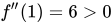
| Failed to parse (Conversion error. Server ("https://wikimedia.org/api/rest_") reported: "Cannot get mml. Server problem."): {\displaystyle f''(x)=12x-6} , then Failed to parse (Conversion error. Server ("https://wikimedia.org/api/rest_") reported: "Cannot get mml. Server problem."): {\displaystyle f''(0)=-6<0} and |
| By the second derivative test, Failed to parse (Conversion error. Server ("https://wikimedia.org/api/rest_") reported: "Cannot get mml. Server problem."): {\displaystyle f(0)=-5} is relative maximum and Failed to parse (Conversion error. Server ("https://wikimedia.org/api/rest_") reported: "Cannot get mml. Server problem."): {\displaystyle f(1)=0} is relative minimum |
| Therefore, relative maximum: Failed to parse (Conversion error. Server ("https://wikimedia.org/api/rest_") reported: "Cannot get mml. Server problem."): {\displaystyle (0,-5)} and relative minimum : |

This page were made by Tri Phan