Difference between revisions of "009B Sample Final 1, Problem 5"

From Math Wiki
Jump to navigation Jump to search
 
(3 intermediate revisions by the same user not shown)
Line 1: Line 1:
<span class="exam"> Consider the solid obtained by rotating the area bounded by the following three functions about the <math style="vertical-align: -3px">y</math>-axis:
+
<span class="exam"> The region bounded by the parabola &nbsp;<math style="vertical-align: -4px">y=x^2</math>&nbsp; and the line &nbsp;<math style="vertical-align: -4px">y=2x</math>&nbsp; in the first quadrant is revolved about the &nbsp;<math style="vertical-align: -4px">y</math>-axis to generate a solid.
  
::::::<span class="exam"> <math style="vertical-align: 0px">x=0</math>, <math style="vertical-align: -4px">y=e^x</math>, and <math style="vertical-align: -4px">y=ex</math>.
+
<span class="exam">(a) Sketch the region bounded by the given functions and find their points of intersection.  
  
::<span class="exam">a) Sketch the region bounded by the given three functions. Find the intersection point of the two functions:
+
<span class="exam">(b) Set up the integral for the volume of the solid.
  
::::::<span class="exam"><math style="vertical-align: -4px">y=e^x</math> and <math style="vertical-align: -4px">y=ex</math>. (There is only one.)
+
<span class="exam">(c) Find the volume of the solid by computing the integral.
 
 
::<span class="exam">b) Set up the integral for the volume of the solid.


::<span class="exam">c) Find the volume of the solid by computing the integral.


{| class="mw-collapsible mw-collapsed" style = "text-align:left;"
 
{| class="mw-collapsible mw-collapsed" style = "text-align:left;"
 
!Foundations: &nbsp;  
 
!Foundations: &nbsp;  
 
|-
 
|-
|Recall:
+
|'''1.''' You can find the intersection points of two functions, say &nbsp; <math style="vertical-align: -5px">f(x),g(x),</math>
 
|-
 
|-
 
|
 
|
::'''1.''' You can find the intersection points of two functions, say <math style="vertical-align: -5px">f(x),g(x),</math>
+
&nbsp; &nbsp; &nbsp; &nbsp; by setting &nbsp;<math style="vertical-align: -5px">f(x)=g(x)</math>&nbsp; and solving for &nbsp;<math style="vertical-align: 0px">x.</math>
 
|-
 
|-
|
+
|'''2.''' The volume of a solid obtained by rotating an area around the &nbsp;<math style="vertical-align: -4px">y</math>-axis using cylindrical shells is given by 
:::by setting <math style="vertical-align: -5px">f(x)=g(x)</math> and solving for <math style="vertical-align: 0px">x.</math>
 
 
|-
 
|-
 
|
 
|
::'''2.''' The volume of a solid obtained by rotating an area around the <math style="vertical-align: -4px">y</math>-axis using cylindrical shells is given by 
+
&nbsp; &nbsp; &nbsp; &nbsp; <math style="vertical-align: -13px">\int 2\pi rh~dx,</math>&nbsp; where &nbsp;<math style="vertical-align: 0px">r</math>&nbsp; is the radius of the shells and &nbsp;<math style="vertical-align: 0px">h</math>&nbsp; is the height of the shells.
|-
 
|
 
:::<math style="vertical-align: -13px">\int 2\pi rh~dx,</math> where <math style="vertical-align: 0px">r</math> is the radius of the shells and <math style="vertical-align: 0px">h</math> is the height of the shells.
 
 
|}
 
|}
 +
  
 
'''Solution:'''
 
'''Solution:'''
Line 36: Line 29:
 
!Step 1: &nbsp;  
 
!Step 1: &nbsp;  
 
|-
 
|-
|First, we sketch the region bounded by the three functions. The region is shown in red, while the revolved solid is shown in blue.
+
|First, we sketch the region bounded by the given functions.
|-
 
|&nbsp;
 
 
|-
 
|-
|[[File:9BF1 5 GP.png|center|500px]]
+
|[[File:009B_SF1_5.png|center|300px]]      
 
|}
 
|}
  
Line 46: Line 37:
 
!Step 2: &nbsp;
 
!Step 2: &nbsp;
 
|-
 
|-
|Setting the equations equal, we have <math style="vertical-align: 0px">e^x=ex.</math>
+
|Setting the equations equal, we have &nbsp;<math style="vertical-align: 0px">x^2=2x.</math>
 +
|-
 +
|Solving for &nbsp;<math style="vertical-align: -4px">x,</math>&nbsp; we get
 +
|-
 +
|&nbsp; &nbsp; &nbsp; &nbsp;<math>\begin{array}{rcl}
 +
\displaystyle{0} & = & \displaystyle{x^2-2x}\\
 +
&&\\
 +
& = & \displaystyle{x(x-2).}
 +
\end{array}</math>
 
|-
 
|-
|We get one intersection point, which is <math style="vertical-align: -4px">(1,e).</math>
+
|So, &nbsp;<math style="vertical-align: 0px">x=0</math>&nbsp; and &nbsp;<math style="vertical-align: 0px">x=2.</math>
 
|-
 
|-
|This intersection point can be seen in the graph shown in Step 1.
+
|If we plug these values into our functions, we get the intersection points
 +
|-
 +
|&nbsp; &nbsp; &nbsp; &nbsp;<math style="vertical-align: -4px">(0,0)</math>&nbsp; and &nbsp;<math style="vertical-align: -4px">(2,4).</math>
 +
|-
 +
|This intersection points can be seen in the graph shown in Step 1.
 
|}
 
|}
  
Line 58: Line 61:
 
!Step 1: &nbsp;  
 
!Step 1: &nbsp;  
 
|-
 
|-
|We proceed using cylindrical shells. The radius of the shells is given by <math style="vertical-align: 0px">r=x.</math>
+
|We proceed using cylindrical shells. The radius of the shells is given by &nbsp;<math style="vertical-align: 0px">r=x.</math>
 
|-
 
|-
|The height of the shells is given by  
+
|The height of the shells is given by &nbsp;<math style="vertical-align: 0px">h=2x-x^2.</math>
|-
 
|
 
::<math style="vertical-align: 0px">h=e^x-ex.</math>
 
 
|}
 
|}
  
Line 72: Line 72:
 
|-
 
|-
 
|
 
|
::<math style="vertical-align: -14px">\int 2\pi rh\,dx\,=\,\int_0^1 2\pi x(e^x-ex)\,dx.</math>
+
&nbsp; &nbsp; &nbsp; &nbsp;<math style="vertical-align: -14px">\int 2\pi rh~dx~=~\int_0^2 2\pi x(2x-x^2)~dx.</math>
 
|}
 
|}
  
Line 83: Line 83:
 
|-
 
|-
 
|
 
|
::<math>\int_0^1 2\pi x(e^x-ex)\,dx\,=\,2\pi\int_0^1 xe^x\,dx-2\pi\int_0^1ex^2\,dx.</math>
+
&nbsp; &nbsp; &nbsp; &nbsp; <math>\int_0^2 2\pi x(2x-x^2)~dx~=~2\pi\int_0^2 2x^2-x^3~dx.</math>
 
|}
 
|}
  
Line 89: Line 89:
 
!Step 2: &nbsp;
 
!Step 2: &nbsp;
 
|-
 
|-
|For the first integral, we need to use integration by parts.
+
|We have
|-
 
|Let <math style="vertical-align: 0px">u=x</math> and <math style="vertical-align: 0px">dv=e^xdx.</math> Then, <math style="vertical-align: 0px">du=dx</math> and <math style="vertical-align: 0px">v=e^x.</math>
 
|-
 
|So, the integral becomes
 
 
|-
 
|-
 
|
 
|
::<math>\begin{array}{rcl}
+
&nbsp; &nbsp; &nbsp; &nbsp;<math>\begin{array}{rcl}
\displaystyle{\int_0^1 2\pi x(e^x-ex)~dx} & = & \displaystyle{2\pi\bigg(xe^x\bigg|_0^1 -\int_0^1 e^xdx\bigg)-\frac{2\pi ex^3}{3}\bigg|_0^1}\\
+
\displaystyle{\int_0^2 2\pi x(2x-x^2)~dx} & = & \displaystyle{2\pi\int_0^2 2x^2-x^3~dx}\\
 
&&\\
 
&&\\
& = & \displaystyle{2\pi\bigg(xe^x-e^x\bigg)\bigg|_0^1-\frac{2\pi e}{3}}\\
+
& = & \displaystyle{2\pi\bigg(\frac{2x^3}{3}-\frac{x^4}{4}\bigg)\bigg|_0^2}\\
 
&&\\
 
&&\\
& = & \displaystyle{2\pi(e-e-(-1))-\frac{2\pi e}{3}}\\
+
& = & \displaystyle{2\pi\bigg(\frac{2^4}{3}-\frac{2^4}{4}\bigg)-2\pi(0)}\\
 
&&\\
 
&&\\
& = & \displaystyle{2\pi-\frac{2\pi e}{3}}.\\
+
& = & \displaystyle{\frac{8\pi}{3}.}\\
 
\end{array}</math>
 
\end{array}</math>
 
|}
 
|}
 +
  
 
{| class="mw-collapsible mw-collapsed" style = "text-align:left;"
 
{| class="mw-collapsible mw-collapsed" style = "text-align:left;"
 
!Final Answer: &nbsp;  
 
!Final Answer: &nbsp;  
 
|-
 
|-
|'''(a)''' &nbsp;<math style="vertical-align: -5px">(1,e)</math> (See Step 1 for the graph)
+
|&nbsp; &nbsp;'''(a)''' &nbsp; &nbsp;<math style="vertical-align: -5px">(0,0),(2,4)</math>&nbsp; (See Step 1 for the graph)
 
|-
 
|-
|'''(b)''' &nbsp;<math style="vertical-align: -15px">\int_0^1 2\pi x(e^x-ex)~dx</math>
+
|&nbsp; &nbsp;'''(b)''' &nbsp; &nbsp;<math style="vertical-align: -15px">\int_0^2 2\pi x(2x-x^2)~dx</math>
 
|-
 
|-
|'''(c)''' &nbsp;<math style="vertical-align: -14px">2\pi-\frac{2\pi e}{3}</math>
+
|&nbsp; &nbsp;'''(c)''' &nbsp; &nbsp;<math style="vertical-align: -14px">\frac{8\pi}{3}</math>
 
|}
 
|}
 
[[009B_Sample_Final_1|'''<u>Return to Sample Exam</u>''']]
 
[[009B_Sample_Final_1|'''<u>Return to Sample Exam</u>''']]

Latest revision as of 11:16, 23 May 2017

The region bounded by the parabola  Failed to parse (MathML with SVG or PNG fallback (recommended for modern browsers and accessibility tools): Invalid response ("Math extension cannot connect to Restbase.") from server "https://wikimedia.org/api/rest_v1/":): {\displaystyle y=x^2}   and the line  Failed to parse (MathML with SVG or PNG fallback (recommended for modern browsers and accessibility tools): Invalid response ("Math extension cannot connect to Restbase.") from server "https://wikimedia.org/api/rest_v1/":): {\displaystyle y=2x}   in the first quadrant is revolved about the  Failed to parse (MathML with SVG or PNG fallback (recommended for modern browsers and accessibility tools): Invalid response ("Math extension cannot connect to Restbase.") from server "https://wikimedia.org/api/rest_v1/":): {\displaystyle y} -axis to generate a solid.

(a) Sketch the region bounded by the given functions and find their points of intersection.

(b) Set up the integral for the volume of the solid.

(c) Find the volume of the solid by computing the integral.

Foundations:  
1. You can find the intersection points of two functions, say   Failed to parse (MathML with SVG or PNG fallback (recommended for modern browsers and accessibility tools): Invalid response ("Math extension cannot connect to Restbase.") from server "https://wikimedia.org/api/rest_v1/":): {\displaystyle f(x),g(x),}

        by setting  Failed to parse (MathML with SVG or PNG fallback (recommended for modern browsers and accessibility tools): Invalid response ("Math extension cannot connect to Restbase.") from server "https://wikimedia.org/api/rest_v1/":): {\displaystyle f(x)=g(x)}   and solving for  Failed to parse (MathML with SVG or PNG fallback (recommended for modern browsers and accessibility tools): Invalid response ("Math extension cannot connect to Restbase.") from server "https://wikimedia.org/api/rest_v1/":): {\displaystyle x.}

2. The volume of a solid obtained by rotating an area around the  Failed to parse (MathML with SVG or PNG fallback (recommended for modern browsers and accessibility tools): Invalid response ("Math extension cannot connect to Restbase.") from server "https://wikimedia.org/api/rest_v1/":): {\displaystyle y} -axis using cylindrical shells is given by

        Failed to parse (MathML with SVG or PNG fallback (recommended for modern browsers and accessibility tools): Invalid response ("Math extension cannot connect to Restbase.") from server "https://wikimedia.org/api/rest_v1/":): {\displaystyle \int 2\pi rh~dx,}   where  Failed to parse (MathML with SVG or PNG fallback (recommended for modern browsers and accessibility tools): Invalid response ("Math extension cannot connect to Restbase.") from server "https://wikimedia.org/api/rest_v1/":): {\displaystyle r}   is the radius of the shells and  Failed to parse (MathML with SVG or PNG fallback (recommended for modern browsers and accessibility tools): Invalid response ("Math extension cannot connect to Restbase.") from server "https://wikimedia.org/api/rest_v1/":): {\displaystyle h}   is the height of the shells.


Solution:

(a)

Step 1:  
First, we sketch the region bounded by the given functions.
009B SF1 5.png
Step 2:  
Setting the equations equal, we have  Failed to parse (MathML with SVG or PNG fallback (recommended for modern browsers and accessibility tools): Invalid response ("Math extension cannot connect to Restbase.") from server "https://wikimedia.org/api/rest_v1/":): {\displaystyle x^2=2x.}
Solving for  Failed to parse (MathML with SVG or PNG fallback (recommended for modern browsers and accessibility tools): Invalid response ("Math extension cannot connect to Restbase.") from server "https://wikimedia.org/api/rest_v1/":): {\displaystyle x,}   we get
       Failed to parse (MathML with SVG or PNG fallback (recommended for modern browsers and accessibility tools): Invalid response ("Math extension cannot connect to Restbase.") from server "https://wikimedia.org/api/rest_v1/":): {\displaystyle \begin{array}{rcl} \displaystyle{0} & = & \displaystyle{x^2-2x}\\ &&\\ & = & \displaystyle{x(x-2).} \end{array}}
So,  Failed to parse (MathML with SVG or PNG fallback (recommended for modern browsers and accessibility tools): Invalid response ("Math extension cannot connect to Restbase.") from server "https://wikimedia.org/api/rest_v1/":): {\displaystyle x=0}   and  Failed to parse (MathML with SVG or PNG fallback (recommended for modern browsers and accessibility tools): Invalid response ("Math extension cannot connect to Restbase.") from server "https://wikimedia.org/api/rest_v1/":): {\displaystyle x=2.}
If we plug these values into our functions, we get the intersection points
       Failed to parse (MathML with SVG or PNG fallback (recommended for modern browsers and accessibility tools): Invalid response ("Math extension cannot connect to Restbase.") from server "https://wikimedia.org/api/rest_v1/":): {\displaystyle (0,0)}   and  Failed to parse (MathML with SVG or PNG fallback (recommended for modern browsers and accessibility tools): Invalid response ("Math extension cannot connect to Restbase.") from server "https://wikimedia.org/api/rest_v1/":): {\displaystyle (2,4).}
This intersection points can be seen in the graph shown in Step 1.

(b)

Step 1:  
We proceed using cylindrical shells. The radius of the shells is given by  Failed to parse (MathML with SVG or PNG fallback (recommended for modern browsers and accessibility tools): Invalid response ("Math extension cannot connect to Restbase.") from server "https://wikimedia.org/api/rest_v1/":): {\displaystyle r=x.}
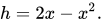
The height of the shells is given by  Failed to parse (MathML with SVG or PNG fallback (recommended for modern browsers and accessibility tools): Invalid response ("Math extension cannot connect to Restbase.") from server "https://wikimedia.org/api/rest_v1/":): {\displaystyle h=2x-x^2.}
Step 2:  
So, the volume of the solid is

       Failed to parse (MathML with SVG or PNG fallback (recommended for modern browsers and accessibility tools): Invalid response ("Math extension cannot connect to Restbase.") from server "https://wikimedia.org/api/rest_v1/":): {\displaystyle \int 2\pi rh~dx~=~\int_0^2 2\pi x(2x-x^2)~dx.}

(c)

Step 1:  
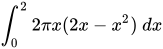
We need to integrate

        Failed to parse (MathML with SVG or PNG fallback (recommended for modern browsers and accessibility tools): Invalid response ("Math extension cannot connect to Restbase.") from server "https://wikimedia.org/api/rest_v1/":): {\displaystyle \int_0^2 2\pi x(2x-x^2)~dx~=~2\pi\int_0^2 2x^2-x^3~dx.}

Step 2:  
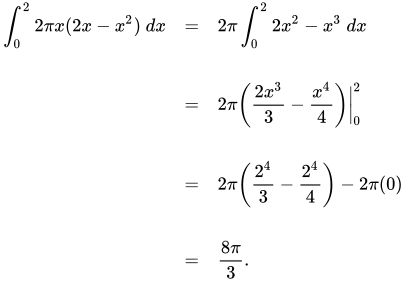
We have

       Failed to parse (MathML with SVG or PNG fallback (recommended for modern browsers and accessibility tools): Invalid response ("Math extension cannot connect to Restbase.") from server "https://wikimedia.org/api/rest_v1/":): {\displaystyle \begin{array}{rcl} \displaystyle{\int_0^2 2\pi x(2x-x^2)~dx} & = & \displaystyle{2\pi\int_0^2 2x^2-x^3~dx}\\ &&\\ & = & \displaystyle{2\pi\bigg(\frac{2x^3}{3}-\frac{x^4}{4}\bigg)\bigg|_0^2}\\ &&\\ & = & \displaystyle{2\pi\bigg(\frac{2^4}{3}-\frac{2^4}{4}\bigg)-2\pi(0)}\\ &&\\ & = & \displaystyle{\frac{8\pi}{3}.}\\ \end{array}}


Final Answer:  
   (a)    Failed to parse (MathML with SVG or PNG fallback (recommended for modern browsers and accessibility tools): Invalid response ("Math extension cannot connect to Restbase.") from server "https://wikimedia.org/api/rest_v1/":): {\displaystyle (0,0),(2,4)}   (See Step 1 for the graph)
   (b)    Failed to parse (MathML with SVG or PNG fallback (recommended for modern browsers and accessibility tools): Invalid response ("Math extension cannot connect to Restbase.") from server "https://wikimedia.org/api/rest_v1/":): {\displaystyle \int_0^2 2\pi x(2x-x^2)~dx}
   (c)    Failed to parse (MathML with SVG or PNG fallback (recommended for modern browsers and accessibility tools): Invalid response ("Math extension cannot connect to Restbase.") from server "https://wikimedia.org/api/rest_v1/":): {\displaystyle \frac{8\pi}{3}}

Return to Sample Exam