Difference between revisions of "022 Sample Final A, Problem 1"
Jump to navigation
Jump to search
| Line 55: | Line 55: | ||
!Step 2: | !Step 2: | ||
|- | |- | ||
| − | |Now we have to find the 4 second derivatives | + | |Now we have to find the 4 second derivatives, We have |
| − | + | <br> | |
| − | + | ::<math>\begin{array}{rcl} | |
| − | <math>\begin{array}{rcl} | + | \displaystyle{\frac{\partial^2f(x,y)}{\partial x^2}\,=\,\frac{\partial}{\partial x} \left(\frac{\partial f(x, y)}{\partial x}\right)} & = & \displaystyle{\frac{\partial}{\partial x}\left(\frac{-2y^2}{(x - y)^2}\right)}\\ |
| − | \displaystyle{\frac{\partial}{\partial x} \frac{\partial f(x, y)}{\partial x}} & = & \displaystyle{\frac{\partial}{\partial x}\left(\frac{-2y^2}{(x - y)^2}\right)}\\ | ||
&&\\ | &&\\ | ||
& = & \displaystyle{\frac{0 - 2(x - y)(-2y^2)}{(x - y)^4}}\\ | & = & \displaystyle{\frac{0 - 2(x - y)(-2y^2)}{(x - y)^4}}\\ | ||
&&\\ | &&\\ | ||
| − | & = & \displaystyle{\frac{4xy^2 - 4y^3}{(x - y)^4}} | + | & = & \displaystyle{\frac{4xy^2 - 4y^3}{(x - y)^4}.} |
\end{array}</math> | \end{array}</math> | ||
|- | |- | ||
| − | | | + | |Also, |
| − | <math>\begin{array}{rcl} | + | <br> |
| − | \displaystyle{\frac{\partial}{\partial y} \frac{\partial f(x, y)}{\partial x}} & = & \displaystyle{\frac{\partial}{\partial y}\left(\frac{-2y^2}{(x - y)^2}\right)}\\ | + | ::<math>\begin{array}{rcl} |
| + | \displaystyle{\frac{\partial^2f(x,y)}{\partial y\partial x}\,=\,\frac{\partial}{\partial y} \left(\frac{\partial f(x, y)}{\partial x}\right)} & = & \displaystyle{\frac{\partial}{\partial y}\left(\frac{-2y^2}{(x - y)^2}\right)}\\ | ||
&&\\ | &&\\ | ||
& = & \displaystyle{\frac{-4y(x - y)^2 -4y^2(x - y)}{(x - y)^4}}\\ | & = & \displaystyle{\frac{-4y(x - y)^2 -4y^2(x - y)}{(x - y)^4}}\\ | ||
&&\\ | &&\\ | ||
& = & \displaystyle{\frac{-4y(x^2 - 2xy + y^2) - 4xy^2 + 4y^3}{(x - y)^4}}\\ | & = & \displaystyle{\frac{-4y(x^2 - 2xy + y^2) - 4xy^2 + 4y^3}{(x - y)^4}}\\ | ||
| − | & = & \displaystyle{\frac{4xy^2 - 4x^2y}{(x - y)^4}} | + | & = & \displaystyle{\frac{4xy^2 - 4x^2y}{(x - y)^4}.} |
\end{array}</math> | \end{array}</math> | ||
|- | |- | ||
| − | | | + | |Showing the equality of mixed partial derivatives, |
| − | <math>\begin{array}{rcl} | + | <br> |
| − | \displaystyle{\frac{\partial}{\partial x} \frac{\partial f(x, y)}{\partial y}} & = & \displaystyle{\frac{\partial}{\partial x}\left(\frac{2x^2}{(x - y)^2}\right)}\\ | + | ::<math>\begin{array}{rcl} |
| + | \displaystyle{\frac{\partial^2f(x,y)}{\partial x\partial y}\,=\,\frac{\partial}{\partial x} \left(\frac{\partial f(x, y)}{\partial y}\right)} & = & \displaystyle{\frac{\partial}{\partial x}\left(\frac{2x^2}{(x - y)^2}\right)}\\ | ||
&&\\ | &&\\ | ||
& = & \displaystyle{\frac{4x(x - y)^2 -2(x - y)2x^2}{(x - y)^4}}\\ | & = & \displaystyle{\frac{4x(x - y)^2 -2(x - y)2x^2}{(x - y)^4}}\\ | ||
| Line 84: | Line 85: | ||
& = & \displaystyle{\frac{4x(x^2 - 2xy + y^2) -4x^3+ 4x^2y}{(x - y)^4}}\\ | & = & \displaystyle{\frac{4x(x^2 - 2xy + y^2) -4x^3+ 4x^2y}{(x - y)^4}}\\ | ||
&&\\ | &&\\ | ||
| − | & = & \displaystyle{\frac{4xy^2 -4x^2y}{(x - y)^4}} | + | & = & \displaystyle{\frac{4xy^2 -4x^2y}{(x - y)^4}.} |
\end{array}</math> | \end{array}</math> | ||
|- | |- | ||
| − | | | + | |Finally, |
| − | + | <br> | |
| − | <math>\begin{array}{rcl} | + | ::<math>\begin{array}{rcl} |
| − | \displaystyle{\frac{\partial}{\partial y} \frac{\partial f(x, y)}{\partial y}} & = & \displaystyle{\frac{\partial}{\partial y}\left(\frac{2x^2}{(x - y)^2}\right)}\\ | + | \displaystyle{\frac{\partial^2f(x,y)}{\partial y^2}\,=\,\frac{\partial}{\partial y} \left(\frac{\partial f(x, y)}{\partial y}\right)} & = & \displaystyle{\frac{\partial}{\partial y}\left(\frac{2x^2}{(x - y)^2}\right)}\\ |
&&\\ | &&\\ | ||
& = & \displaystyle{\frac{0 + 2(x - y)(2x^2)}{(x - y)^4}}\\ | & = & \displaystyle{\frac{0 + 2(x - y)(2x^2)}{(x - y)^4}}\\ | ||
&&\\ | &&\\ | ||
| − | & = & \displaystyle{\frac{4x^3 - 4x^2y}{(x - y)^4}} | + | & = & \displaystyle{\frac{4x^3 - 4x^2y}{(x - y)^4}.} |
\end{array}</math> | \end{array}</math> | ||
|} | |} | ||
| Line 101: | Line 102: | ||
!Final Answer: | !Final Answer: | ||
|- | |- | ||
| − | |<math>\displaystyle{\frac{\partial}{\partial x} f(x, y) = \frac{-2y^2}{(x - y)^2} \qquad | + | |The first partial derivatives are: |
| − | \frac{\partial}{\partial y} f(x, y) = \frac{2x^2}{(x - y)^2} | + | ::<math>\displaystyle{\frac{\partial}{\partial x} f(x, y) = \frac{-2y^2}{(x - y)^2}, \qquad |
| + | \frac{\partial}{\partial y} f(x, y) = \frac{2x^2}{(x - y)^2}.}</math> | ||
|- | |- | ||
| − | | | + | |The second partial derivatives are: |
| − | <math> | + | ::<math>\frac{\partial^{2}f(x,y)}{\partial x^{2}}\,=\,\frac{4xy^{2}-4y^{3}}{(x-y)^{4}}, |
| − | \frac{\partial | + | \qquad\frac{\partial^{2}f(x,y)}{\partial x\partial y}\,=\,\frac{\partial^{2}f(x,y)}{\partial y\partial x}\,=\,\frac{4xy^{2}-4x^{2}y}{(x-y)^{4}},\qquad\frac{\partial^{2}f(x,y)}{\partial y^{2}}\,=\,\frac{4x^{3}-4x^{2y}}{(x-y)^{4}}.</math> |
| − | \frac{\partial | ||
| − | \frac{\partial | ||
| − | </math> | ||
|} | |} | ||
[[022_Sample_Final_A|'''<u>Return to Sample Exam</u>''']] | [[022_Sample_Final_A|'''<u>Return to Sample Exam</u>''']] | ||
Revision as of 18:59, 6 June 2015
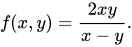
Find all first and second partial derivatives of the following function, and demostrate that the mixed second partials are equal for the function
| Foundations: |
|---|
| 1) Which derivative rules do you have to use for this problem? |
| 2) What is the partial derivative of , with respect to ? |
| Answers: |
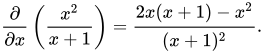
| 1) You have to use the quotient rule and product rule. The quotient rule says that
so The product rule says This means |
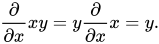
| 2) The partial derivative is , since we treat anything not involving as a constant and take the derivative with respect to . In more detail, we have
|




![{\displaystyle {\frac {\partial }{\partial x}}[x(x+1)]=(x+1)+x.}](https://wikimedia.org/api/rest_v1/media/math/render/svg/3df6da3b583bff7cff703c6e7aa2f2b81a47370d)

Solution:
| Step 1: |
|---|
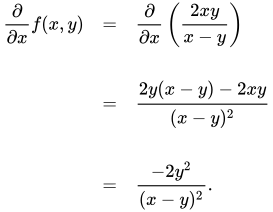
| First, we start by finding the first partial derivatives. So we have to take the partial derivative of with respect to , and the partial derivative of with respect to . This gives us the following: |
|
|
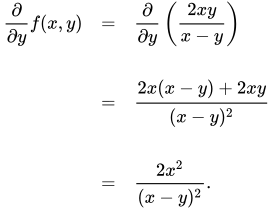
| This gives us the derivative with respect to . To find the derivative with respect to , we do the following: |
|
|

| Step 2: |
|---|
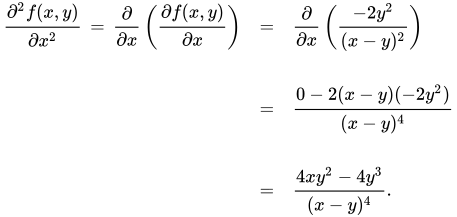
| Now we have to find the 4 second derivatives, We have
|
| Also,
|
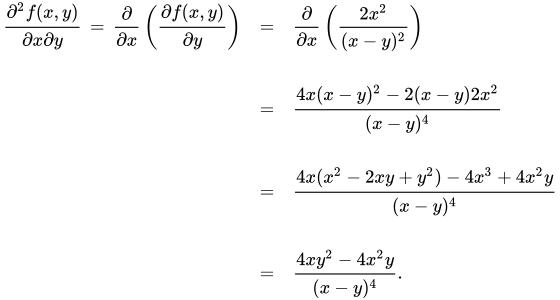
| Showing the equality of mixed partial derivatives,
|
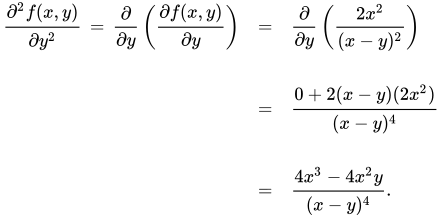
| Finally,
|

| Final Answer: |
|---|
| The first partial derivatives are:
|
| The second partial derivatives are:
|

