Difference between revisions of "022 Sample Final A, Problem 3"

From Math Wiki
Jump to navigation Jump to search
 
Line 10: Line 10:
 
|3) What special integral do we have to use?
 
|3) What special integral do we have to use?
 
|-
 
|-
|Answer:
+
|Answers:
 
|-
 
|-
|1) Since <math>x^2 - x - 12 = (x - 4)(x +3)</math> &nbsp;, and each term has multiplicity one, the decomposition will be of the form: <math>\frac{A}{x - 4} + \frac{B}{x + 3}</math>
+
|1) Since <math style="vertical-align: -5px">x^2 - x - 12 = (x - 4)(x +3)</math>&thinsp;, and each term has multiplicity one, the decomposition will be of the form:&thinsp; <math style="vertical-align: -15px">\frac{A}{x - 4} + \frac{B}{x + 3}</math>.
 
|-
 
|-
|2) After writing the equality, <math>\frac{6}{x^2 -x - 12} = \frac{A}{x - 4} + \frac{B}{x + 3}</math>, clear the denominators, and evaluate both sides at x = 4, -3, Each evaluation will yield the value of one of the unknowns.
+
|2) After writing the equality, <math style="vertical-align: -15px">\frac{6}{x^2 -x - 12} \,=\, \frac{A}{x - 4} + \frac{B}{x + 3}</math>, clear the denominators, and evaluate both sides at <math style="vertical-align: -4px">x = 4, -3</math>. Each evaluation will yield the value of one of the unknowns.
 
|-
 
|-
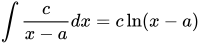
|3) We have to remember that <math>\int \frac{c}{x - a} dx = c\ln(x - a)</math>&nbsp;, for any numbers c, a.
+
|3) We have to remember that <math style="vertical-align: -13px">\int \frac{c}{x - a} dx = c\ln(x - a)</math>&nbsp;, for any numbers <math style="vertical-align: -4px">c, a</math>.
 
|}
 
|}
  
Line 24: Line 24:
 
!Step 1: &nbsp;
 
!Step 1: &nbsp;
 
|-
 
|-
|First, we factor <math>x^2 - x - 12 = (x - 4)(x + 3)</math>
+
|First, we factor: <math style="vertical-align: -5px">x^2 - x - 12 = (x - 4)(x +3)</math>&thinsp;.
 
|}
 
|}
  
Line 30: Line 30:
 
!Step 2: &nbsp;
 
!Step 2: &nbsp;
 
|-
 
|-
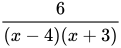
|Now we want to find the partial fraction expansion for <math>\frac{6}{(x - 4)(x + 3)}</math>&nbsp;, which will have the form <math>\frac{A}{x - 4} + {B}{x + 3}</math>
+
|Now we want to find the partial fraction expansion for <math>\frac{6}{(x - 4)(x + 3)}</math>&nbsp;, which will have the form <math style="vertical-align: -20px">\frac{A}{x - 4} + \frac{B}{x + 3}</math>.
 
|-
 
|-
|To do this we need to solve the equation <math>6 = A( x + 3) + B(x - 4)</math>
+
|To do this, we need to solve the equation&thinsp; <math style="vertical-align: -5px">6 \,=\, A( x + 3) + B(x - 4)</math>.
 
|-
 
|-
|Plugging in -3 for x to both sides we find that <math>6 = -7B</math> &nbsp; and &nbsp; <math>B = -\frac{6}{7}</math>.
+
|Plugging in&thinsp; <math style="vertical-align: 0px">-3</math> for <math style="vertical-align: 0px">x</math>, we find that&thinsp; <math style="vertical-align: -0.2px">6 \,=\, -7B</math>&thinsp;, and thus&thinsp; <math style="vertical-align: -13px">B = -\frac{6}{7}</math>&thinsp;.
 
|-
 
|-
|Now we can find A by plugging in 4 for x to both sides. This yields <math>6 = 7A</math>&nbsp;, so <math>A = \frac{6}{7}</math>
+
|Similarly, we can find <math style="vertical-align: -0px">A</math> by plugging in <math style="vertical-align: -1px">4</math> for <math style="vertical-align: 0px">x</math>. This yields <math style="vertical-align: -0.2px">6 = 7A</math>&nbsp;, so <math style="vertical-align: -13px">A = \frac{6}{7}</math>&thinsp;.
 
|-
 
|-
|Finally we have the partial fraction expansion: <math>\frac{6}{x^2 -x - 12} = \frac{6}{7(x - 4)} - \frac{6}{7(x + 3)}</math>
+
|This completes the partial fraction expansion:
 +
::<math>\frac{6}{x^2 -x - 12} \,=\, \frac{6}{7(x - 4)} - \frac{6}{7(x + 3)}.</math>
 
|}
 
|}
  
Line 44: Line 45:
 
!Step 3: &nbsp;
 
!Step 3: &nbsp;
 
|-
 
|-
|Now to finish the problem we integrate each fraction to get: <math>\int \frac{6}{x^2 -x -12} dx = \int \frac{6}{7(x - 4)}dx  - \int \frac{6}{7(x + 3)}dx </math>&nbsp; to get &nbsp;<math>\frac{6}{7}\ln(x - 4) - \frac{6}{7}\ln(x + 3)</math>
+
|By the previous step, we have
 +
::<math>\int \frac{6}{x^2 -x -12} dx \,=\, \int \frac{6}{7(x - 4)}dx  - \int \frac{6}{7(x + 3)}dx.</math>
 +
|-
 +
|Integrating by the rule in 'Foundations',
 +
::<math>\int \frac{6}{x^2 -x -12} dx \,=\, \frac{6}{7}\ln(x - 4) - \frac{6}{7}\ln(x + 3).</math>
 
|}
 
|}
  
Line 50: Line 55:
 
!Step 4: &nbsp;
 
!Step 4: &nbsp;
 
|-
 
|-
|Now make sure you remember to add the <math> + C</math> to the integral at the end.
+
|Now, make sure you remember to add the&thinsp; <math style="vertical-align: -2px"> + C</math>&thinsp; to the integral at the end.
 
|}
 
|}
  
Line 56: Line 61:
 
!Final Answer: &nbsp;
 
!Final Answer: &nbsp;
 
|-
 
|-
|<math>\frac{6}{7}\ln(x - 4) - \frac{6}{7}\ln(x + 3) + C</math>
+
|
 +
::<math>\frac{6}{7}\ln(x - 4) - \frac{6}{7}\ln(x + 3) + C.</math>
 
|}
 
|}


[[022_Sample Final A|'''<u>Return to Sample Final</u>''']]
 
[[022_Sample Final A|'''<u>Return to Sample Final</u>''']]

Latest revision as of 18:10, 6 June 2015

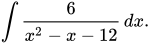
Find the antiderivative:
Foundations:  
1) What does the denominator factor into? What will be the form of the decomposition?
2) How do you solve for the numerators?
3) What special integral do we have to use?
Answers:
1) Since  , and each term has multiplicity one, the decomposition will be of the form:  Failed to parse (MathML with SVG or PNG fallback (recommended for modern browsers and accessibility tools): Invalid response ("Math extension cannot connect to Restbase.") from server "https://wikimedia.org/api/rest_v1/":): {\displaystyle \frac{A}{x - 4} + \frac{B}{x + 3}} .
2) After writing the equality, Failed to parse (MathML with SVG or PNG fallback (recommended for modern browsers and accessibility tools): Invalid response ("Math extension cannot connect to Restbase.") from server "https://wikimedia.org/api/rest_v1/":): {\displaystyle \frac{6}{x^2 -x - 12} \,=\, \frac{A}{x - 4} + \frac{B}{x + 3}} , clear the denominators, and evaluate both sides at Failed to parse (MathML with SVG or PNG fallback (recommended for modern browsers and accessibility tools): Invalid response ("Math extension cannot connect to Restbase.") from server "https://wikimedia.org/api/rest_v1/":): {\displaystyle x = 4, -3} . Each evaluation will yield the value of one of the unknowns.
3) We have to remember that Failed to parse (MathML with SVG or PNG fallback (recommended for modern browsers and accessibility tools): Invalid response ("Math extension cannot connect to Restbase.") from server "https://wikimedia.org/api/rest_v1/":): {\displaystyle \int \frac{c}{x - a} dx = c\ln(x - a)}  , for any numbers Failed to parse (MathML with SVG or PNG fallback (recommended for modern browsers and accessibility tools): Invalid response ("Math extension cannot connect to Restbase.") from server "https://wikimedia.org/api/rest_v1/":): {\displaystyle c, a} .

Solution:

Step 1:  
First, we factor: Failed to parse (MathML with SVG or PNG fallback (recommended for modern browsers and accessibility tools): Invalid response ("Math extension cannot connect to Restbase.") from server "https://wikimedia.org/api/rest_v1/":): {\displaystyle x^2 - x - 12 = (x - 4)(x +3)}  .
Step 2:  
Now we want to find the partial fraction expansion for Failed to parse (MathML with SVG or PNG fallback (recommended for modern browsers and accessibility tools): Invalid response ("Math extension cannot connect to Restbase.") from server "https://wikimedia.org/api/rest_v1/":): {\displaystyle \frac{6}{(x - 4)(x + 3)}}  , which will have the form Failed to parse (MathML with SVG or PNG fallback (recommended for modern browsers and accessibility tools): Invalid response ("Math extension cannot connect to Restbase.") from server "https://wikimedia.org/api/rest_v1/":): {\displaystyle \frac{A}{x - 4} + \frac{B}{x + 3}} .
To do this, we need to solve the equation  Failed to parse (MathML with SVG or PNG fallback (recommended for modern browsers and accessibility tools): Invalid response ("Math extension cannot connect to Restbase.") from server "https://wikimedia.org/api/rest_v1/":): {\displaystyle 6 \,=\, A( x + 3) + B(x - 4)} .
Plugging in  Failed to parse (MathML with SVG or PNG fallback (recommended for modern browsers and accessibility tools): Invalid response ("Math extension cannot connect to Restbase.") from server "https://wikimedia.org/api/rest_v1/":): {\displaystyle -3} for Failed to parse (MathML with SVG or PNG fallback (recommended for modern browsers and accessibility tools): Invalid response ("Math extension cannot connect to Restbase.") from server "https://wikimedia.org/api/rest_v1/":): {\displaystyle x} , we find that  Failed to parse (MathML with SVG or PNG fallback (recommended for modern browsers and accessibility tools): Invalid response ("Math extension cannot connect to Restbase.") from server "https://wikimedia.org/api/rest_v1/":): {\displaystyle 6 \,=\, -7B}  , and thus  Failed to parse (MathML with SVG or PNG fallback (recommended for modern browsers and accessibility tools): Invalid response ("Math extension cannot connect to Restbase.") from server "https://wikimedia.org/api/rest_v1/":): {\displaystyle B = -\frac{6}{7}}  .
Similarly, we can find Failed to parse (MathML with SVG or PNG fallback (recommended for modern browsers and accessibility tools): Invalid response ("Math extension cannot connect to Restbase.") from server "https://wikimedia.org/api/rest_v1/":): {\displaystyle A} by plugging in Failed to parse (MathML with SVG or PNG fallback (recommended for modern browsers and accessibility tools): Invalid response ("Math extension cannot connect to Restbase.") from server "https://wikimedia.org/api/rest_v1/":): {\displaystyle 4} for Failed to parse (MathML with SVG or PNG fallback (recommended for modern browsers and accessibility tools): Invalid response ("Math extension cannot connect to Restbase.") from server "https://wikimedia.org/api/rest_v1/":): {\displaystyle x} . This yields Failed to parse (MathML with SVG or PNG fallback (recommended for modern browsers and accessibility tools): Invalid response ("Math extension cannot connect to Restbase.") from server "https://wikimedia.org/api/rest_v1/":): {\displaystyle 6 = 7A}  , so Failed to parse (MathML with SVG or PNG fallback (recommended for modern browsers and accessibility tools): Invalid response ("Math extension cannot connect to Restbase.") from server "https://wikimedia.org/api/rest_v1/":): {\displaystyle A = \frac{6}{7}}  .
This completes the partial fraction expansion:
Failed to parse (MathML with SVG or PNG fallback (recommended for modern browsers and accessibility tools): Invalid response ("Math extension cannot connect to Restbase.") from server "https://wikimedia.org/api/rest_v1/":): {\displaystyle \frac{6}{x^2 -x - 12} \,=\, \frac{6}{7(x - 4)} - \frac{6}{7(x + 3)}.}
Step 3:  
By the previous step, we have
Failed to parse (MathML with SVG or PNG fallback (recommended for modern browsers and accessibility tools): Invalid response ("Math extension cannot connect to Restbase.") from server "https://wikimedia.org/api/rest_v1/":): {\displaystyle \int \frac{6}{x^2 -x -12} dx \,=\, \int \frac{6}{7(x - 4)}dx - \int \frac{6}{7(x + 3)}dx.}
Integrating by the rule in 'Foundations',
Failed to parse (MathML with SVG or PNG fallback (recommended for modern browsers and accessibility tools): Invalid response ("Math extension cannot connect to Restbase.") from server "https://wikimedia.org/api/rest_v1/":): {\displaystyle \int \frac{6}{x^2 -x -12} dx \,=\, \frac{6}{7}\ln(x - 4) - \frac{6}{7}\ln(x + 3).}
Step 4:  
Now, make sure you remember to add the  Failed to parse (MathML with SVG or PNG fallback (recommended for modern browsers and accessibility tools): Invalid response ("Math extension cannot connect to Restbase.") from server "https://wikimedia.org/api/rest_v1/":): {\displaystyle + C}   to the integral at the end.
Final Answer:  
Failed to parse (MathML with SVG or PNG fallback (recommended for modern browsers and accessibility tools): Invalid response ("Math extension cannot connect to Restbase.") from server "https://wikimedia.org/api/rest_v1/":): {\displaystyle \frac{6}{7}\ln(x - 4) - \frac{6}{7}\ln(x + 3) + C.}


Return to Sample Final