Difference between revisions of "022 Sample Final A, Problem 1"
Jump to navigation
Jump to search
| Line 1: | Line 1: | ||
<span class="exam">Find all first and second partial derivatives of the following function, and demostrate that the mixed second partials are equal for the function <math> f(x, y) = \frac{2xy}{x-y}.</math> | <span class="exam">Find all first and second partial derivatives of the following function, and demostrate that the mixed second partials are equal for the function <math> f(x, y) = \frac{2xy}{x-y}.</math> | ||
| + | |||
| + | |||
| + | {| class="mw-collapsible mw-collapsed" style = "text-align:left;" | ||
| + | !Foundations: | ||
| + | |- | ||
| + | |1)Which derivative rules do you have to use for this problem? | ||
| + | |- | ||
| + | |2)What is the partial derivative of xy, with respect to x? | ||
| + | |- | ||
| + | |1)You have to use the quotient rule, and product rule. The quotient rule says that <math>\frac{\partial}{\partial x} \left(\frac{f(x)}{g(x)}\right) = \frac{f'(x)g(x) - g'(x)f(x)}{g(x)^2}</math>, so <math>\frac{\partial}{\partial x} \left(\frac{x^2}{x + 1}\right) = \frac{2x(x + 1) - x^2}{(x + 1)^2}</math>. The product rule says <math>\frac{\partial}{\partial x} f(x)g(x) = f'(x)g(x) + g'(x)f(x) </math>. This means <math>\frac{\partial}{\partial x} x(x + 1) = (x + 1) + x </math> | ||
| + | |- | ||
| + | |2) The partial derivative is y, since we treat anything not involving x as a constant and take the derivative with respect to x. So <math>\frac{\partial}{\partial y} xy = x\frac{\partial}{\partial y} y = x.</math> | ||
| + | |} | ||
| + | |||
| + | '''Solution:''' | ||
| + | {| class="mw-collapsible mw-collapsed" style = "text-align:left;" | ||
| + | !Foundations: | ||
| + | |- | ||
| + | |The word 'marginal' should make you immediately think of a derivative. In this case, the marginal is just the partial derivative with respect to a particular variable. | ||
| + | |- | ||
| + | |The teacher has also added the additional restriction that you should not leave your answer with negative exponents. | ||
| + | |} | ||
Revision as of 09:45, 5 June 2015
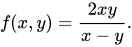
Find all first and second partial derivatives of the following function, and demostrate that the mixed second partials are equal for the function
| Foundations: |
|---|
| 1)Which derivative rules do you have to use for this problem? |
| 2)What is the partial derivative of xy, with respect to x? |
| 1)You have to use the quotient rule, and product rule. The quotient rule says that , so Failed to parse (MathML with SVG or PNG fallback (recommended for modern browsers and accessibility tools): Invalid response ("Math extension cannot connect to Restbase.") from server "https://wikimedia.org/api/rest_v1/":): {\displaystyle \frac{\partial}{\partial x} \left(\frac{x^2}{x + 1}\right) = \frac{2x(x + 1) - x^2}{(x + 1)^2}} . The product rule says Failed to parse (MathML with SVG or PNG fallback (recommended for modern browsers and accessibility tools): Invalid response ("Math extension cannot connect to Restbase.") from server "https://wikimedia.org/api/rest_v1/":): {\displaystyle \frac{\partial}{\partial x} f(x)g(x) = f'(x)g(x) + g'(x)f(x) } . This means Failed to parse (MathML with SVG or PNG fallback (recommended for modern browsers and accessibility tools): Invalid response ("Math extension cannot connect to Restbase.") from server "https://wikimedia.org/api/rest_v1/":): {\displaystyle \frac{\partial}{\partial x} x(x + 1) = (x + 1) + x } |
| 2) The partial derivative is y, since we treat anything not involving x as a constant and take the derivative with respect to x. So Failed to parse (MathML with SVG or PNG fallback (recommended for modern browsers and accessibility tools): Invalid response ("Math extension cannot connect to Restbase.") from server "https://wikimedia.org/api/rest_v1/":): {\displaystyle \frac{\partial}{\partial y} xy = x\frac{\partial}{\partial y} y = x.} |

Solution:
| Foundations: |
|---|
| The word 'marginal' should make you immediately think of a derivative. In this case, the marginal is just the partial derivative with respect to a particular variable. |
| The teacher has also added the additional restriction that you should not leave your answer with negative exponents. |