|
|
| Line 1: |
Line 1: |
| | | | |
| | | | |
| − | <span class="exam"> Use implicit differentiation to find <math>\frac{dy}{dx}: \qquad x+y = x^3y^3</math> | + | <span class="exam"> Use implicit differentiation to find <math>\frac{dy}{dx}: \qquad x+y = x^3y^3</math> |
| | | | |
| | {| class="mw-collapsible mw-collapsed" style = "text-align:left;" | | {| class="mw-collapsible mw-collapsed" style = "text-align:left;" |
Revision as of 16:15, 4 June 2015
Use implicit differentiation to find 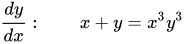
| Foundations:
|
When we use implicit differentiation, we combine the chain rule with the fact that  is a function of is a function of  , and could really be written as , and could really be written as  Because of this, the derivative of Failed to parse (MathML with SVG or PNG fallback (recommended for modern browsers and accessibility tools): Invalid response ("Math extension cannot connect to Restbase.") from server "https://wikimedia.org/api/rest_v1/":): {\displaystyle y^3}
with respect to Failed to parse (MathML with SVG or PNG fallback (recommended for modern browsers and accessibility tools): Invalid response ("Math extension cannot connect to Restbase.") from server "https://wikimedia.org/api/rest_v1/":): {\displaystyle x}
requires the chain rule, so Because of this, the derivative of Failed to parse (MathML with SVG or PNG fallback (recommended for modern browsers and accessibility tools): Invalid response ("Math extension cannot connect to Restbase.") from server "https://wikimedia.org/api/rest_v1/":): {\displaystyle y^3}
with respect to Failed to parse (MathML with SVG or PNG fallback (recommended for modern browsers and accessibility tools): Invalid response ("Math extension cannot connect to Restbase.") from server "https://wikimedia.org/api/rest_v1/":): {\displaystyle x}
requires the chain rule, so
|
| Failed to parse (MathML with SVG or PNG fallback (recommended for modern browsers and accessibility tools): Invalid response ("Math extension cannot connect to Restbase.") from server "https://wikimedia.org/api/rest_v1/":): {\displaystyle \frac{d}{dx}\left(y^{3}\right)=3y^{2}\cdot\frac{dy}{dx}.}
|
| For this problem we also need to use the product rule.
|
Solution:
| Step 1:
|
| First, we differentiate each term separately with respect to Failed to parse (MathML with SVG or PNG fallback (recommended for modern browsers and accessibility tools): Invalid response ("Math extension cannot connect to Restbase.") from server "https://wikimedia.org/api/rest_v1/":): {\displaystyle x}
and apply the product rule on the right hand side to find that Failed to parse (MathML with SVG or PNG fallback (recommended for modern browsers and accessibility tools): Invalid response ("Math extension cannot connect to Restbase.") from server "https://wikimedia.org/api/rest_v1/":): {\displaystyle x + y = x^3y^3}
differentiates implicitly to
|
- Failed to parse (MathML with SVG or PNG fallback (recommended for modern browsers and accessibility tools): Invalid response ("Math extension cannot connect to Restbase.") from server "https://wikimedia.org/api/rest_v1/":): {\displaystyle 1 + \frac{dy}{dx} = 3x^2y^3 + 3x^3y^2 \cdot \frac{dy}{dx}}
.
|
| Step 2:
|
| Now we need to solve for Failed to parse (MathML with SVG or PNG fallback (recommended for modern browsers and accessibility tools): Invalid response ("Math extension cannot connect to Restbase.") from server "https://wikimedia.org/api/rest_v1/":): {\displaystyle \frac{dy}{dx}}
and doing so we find that Failed to parse (MathML with SVG or PNG fallback (recommended for modern browsers and accessibility tools): Invalid response ("Math extension cannot connect to Restbase.") from server "https://wikimedia.org/api/rest_v1/":): {\displaystyle \frac{dy}{dx} = \frac{3x^2y^3 - 1}{1 - 3x^3y^2}}
|
| Final Answer:
|
| Failed to parse (MathML with SVG or PNG fallback (recommended for modern browsers and accessibility tools): Invalid response ("Math extension cannot connect to Restbase.") from server "https://wikimedia.org/api/rest_v1/":): {\displaystyle \frac{dy}{dx} = \frac{3x^2y^3 - 1}{1 - 3x^3y^2}}
|
Return to Sample Exam