Difference between revisions of "022 Exam 2 Sample B, Problem 3"
Jump to navigation
Jump to search
| Line 21: | Line 21: | ||
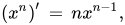
::<math style="vertical-align: -21%;">\left(x^n\right)'\,=\,nx^{n-1},</math> for <math style="vertical-align: -25%;">n\neq 0</math>, | ::<math style="vertical-align: -21%;">\left(x^n\right)'\,=\,nx^{n-1},</math> for <math style="vertical-align: -25%;">n\neq 0</math>, | ||
|- | |- | ||
| − | |as well as the derivative of the exponential function, <math>e^x</math>: | + | |as well as the derivative of the exponential function, <math style="vertical-align: 5%">e^x</math>: |
|- | |- | ||
| | | | ||
| − | ::<math> | + | ::<math>(e^x)'\,=\,e^x.</math> |
|<br> | |<br> | ||
|} | |} | ||
Revision as of 06:46, 17 May 2015
Find the derivative of .

| Foundations: | |
|---|---|
| This problem requires several advanced rules of differentiation. In particular, you need | |
| The Chain Rule: If and are differentiable functions, then | |
The Product Rule: If and are differentiable functions, then | |
| Additionally, we will need our power rule for differentiation: | |
| |
| as well as the derivative of the exponential function, : | |
|
|






Solution:
| Step 1: |
|---|
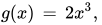
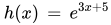
| We need to start by identifying the two functions that are being multiplied together so we can apply the product rule. |
|
| Step 2: |
|---|
| We can now apply the three advanced techniques.This allows us to see that |
|
|
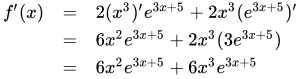
| Final Answer: |
|---|
|
|
