Difference between revisions of "022 Exam 2 Sample A, Problem 1"
Jump to navigation
Jump to search
| Line 47: | Line 47: | ||
!Step 2: | !Step 2: | ||
|- | |- | ||
| − | |We can now apply | + | |We can now apply the advanced techniques. For <math style="vertical-align: -20%">f'(x)</math>, we can avoid using the product rule by first multiplying out the denominator. Then by the quotient rule, |
|- | |- | ||
|<br> | |<br> | ||
::<math>\begin{array}{rcl} | ::<math>\begin{array}{rcl} | ||
| − | f'(x) & = & \displaystyle{\frac{\left | + | f'(x) & = & \displaystyle{\frac{\left[(x+5)(x-1)\right]'x-(x+5)(x-1)(x)'}{x^{2}}}\\ |
\\ | \\ | ||
| − | & = & \displaystyle{\frac{\left | + | & = & \displaystyle{\frac{\left(x^{2}+4x-5\right)'x-(x^{2}+4x-5)(x)'}{x^{2}}}\\ |
\\ | \\ | ||
& = & \displaystyle{\frac{(2x+4)x-(x^{2}+4x-5)(1)}{x^{2}}}\\ | & = & \displaystyle{\frac{(2x+4)x-(x^{2}+4x-5)(1)}{x^{2}}}\\ | ||
Revision as of 10:22, 16 May 2015
Find the derivative of

| Foundations: | |
|---|---|
| This problem requires several advanced rules of differentiation. In particular, you need | |
| The Chain Rule: If and are differentiable functions, then | |
The Product Rule: If and are differentiable functions, then | |
The Quotient Rule: If and are differentiable functions and , then | |
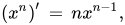
| Additionally, we will need our power rule for differentiation: | |
| |
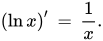
| as well as the derivative of natural log: | |
|
|







Solution:
| Step 1: |
|---|
| We need to identify the composed functions in order to apply the chain rule. Note that if we set Failed to parse (Conversion error. Server ("https://wikimedia.org/api/rest_") reported: "Cannot get mml. Server problem."): {\displaystyle g(x)\,=\,\ln x} , and |
|
|
| we then have Failed to parse (Conversion error. Server ("https://wikimedia.org/api/rest_") reported: "Cannot get mml. Server problem."): {\displaystyle y\,=\,g\circ f(x)\,=\,g\left(f(x)\right).} |

| Step 2: | |
|---|---|
| We can now apply the advanced techniques. For , we can avoid using the product rule by first multiplying out the denominator. Then by the quotient rule, | |

![{\displaystyle {\begin{array}{rcl}f'(x)&=&\displaystyle {\frac {\left[(x+5)(x-1)\right]'x-(x+5)(x-1)(x)'}{x^{2}}}\\\\&=&\displaystyle {\frac {\left(x^{2}+4x-5\right)'x-(x^{2}+4x-5)(x)'}{x^{2}}}\\\\&=&\displaystyle {\frac {(2x+4)x-(x^{2}+4x-5)(1)}{x^{2}}}\\\\&=&\displaystyle {\frac {2x^{2}+4x-x^{2}-4x+5}{x^{2}}}\\\\&=&\displaystyle {\frac {x^{2}+5}{x^{2}}}.\end{array}}}](https://wikimedia.org/api/rest_v1/media/math/render/svg/a9ad641c4ccca6404a5dd64bd51deacf6a604c13)
| Step 3: |
|---|
| We can now use the chain rule to find |
|
Note that many teachers do not prefer a cleaned up answer, and may request that you do not simplify. In this case, we could write the answer as |
|
|


| Final Answer: |
|---|
