Difference between revisions of "022 Exam 2 Sample A, Problem 2"
Jump to navigation
Jump to search
(Created page with "<span class="exam"> Find the antiderivative of <math style="vertical-align: -10%">y\,=\,3x^2-12x+8.</math> {| class="mw-collapsible mw-collapsed" style = "text-align:...") |
|||
| (2 intermediate revisions by the same user not shown) | |||
| Line 7: | Line 7: | ||
|- | |- | ||
| | | | ||
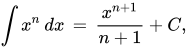
| − | ::<math style="vertical-align: -70%;">\int x^n\,dx\,=\,\frac{x^{n+1}}{n+1} +C,</math>  for <math style="vertical-align: -25%;"> | + | ::<math style="vertical-align: -70%;">\int x^n\,dx\,=\,\frac{x^{n+1}}{n+1} +C,</math>  for <math style="vertical-align: -25%;">n\neq -1.</math> |
|- | |- | ||
|Also, like derivatives, multiplication by a constant and addition/subtraction are respected by the antiderivative: | |Also, like derivatives, multiplication by a constant and addition/subtraction are respected by the antiderivative: | ||
| Line 24: | Line 24: | ||
<math>\begin{array}{rcl} | <math>\begin{array}{rcl} | ||
\int y\, dx & = & \int3x^{2}-12x+8\, dx\\ | \int y\, dx & = & \int3x^{2}-12x+8\, dx\\ | ||
| + | \\ | ||
& = & 3\cdot \frac{x^3}{3}-12\cdot \frac{x^2}{2}+8x+C\\ | & = & 3\cdot \frac{x^3}{3}-12\cdot \frac{x^2}{2}+8x+C\\ | ||
| − | + | \\ | |
| + | & = & x^3-6x^2+8x+C.\end{array}</math> | ||
|- | |- | ||
|Do <u>'''not'''</u> forget the constant when evaluating an antiderivative (i.e., an integral without upper and lower bounds)! | |Do <u>'''not'''</u> forget the constant when evaluating an antiderivative (i.e., an integral without upper and lower bounds)! | ||
| Line 37: | Line 39: | ||
| | | | ||
::<math>x^3-6x^2+8x+C.</math> | ::<math>x^3-6x^2+8x+C.</math> | ||
| + | |} | ||
[[022_Exam_2_Sample_A|'''<u>Return to Sample Exam</u>''']] | [[022_Exam_2_Sample_A|'''<u>Return to Sample Exam</u>''']] | ||
Latest revision as of 07:49, 16 May 2015
Find the antiderivative of Failed to parse (MathML with SVG or PNG fallback (recommended for modern browsers and accessibility tools): Invalid response ("Math extension cannot connect to Restbase.") from server "https://wikimedia.org/api/rest_v1/":): {\displaystyle y\,=\,3x^2-12x+8.}
| Foundations: |
|---|
| We only require some fundamental rules for antiderivatives/integrals. We have the power rule: |
|
| Also, like derivatives, multiplication by a constant and addition/subtraction are respected by the antiderivative: |
|
| Solution: |
|---|
| We can apply the rules listed above to find |
|
Failed to parse (MathML with SVG or PNG fallback (recommended for modern browsers and accessibility tools): Invalid response ("Math extension cannot connect to Restbase.") from server "https://wikimedia.org/api/rest_v1/":): {\displaystyle \begin{array}{rcl} \int y\, dx & = & \int3x^{2}-12x+8\, dx\\ \\ & = & 3\cdot \frac{x^3}{3}-12\cdot \frac{x^2}{2}+8x+C\\ \\ & = & x^3-6x^2+8x+C.\end{array}} |
| Do not forget the constant when evaluating an antiderivative (i.e., an integral without upper and lower bounds)! |
| Final Answer: |
|---|
|