Difference between revisions of "022 Exam 2 Sample B, Problem 7"
Jump to navigation
Jump to search
(Created page with "<span class="exam">Find the antiderivatives: ::<span class="exam">(a) <math> \int xe^{3x^2+1}\,dx.</math> <br> ::<span class="exam">(b) <math>\int_2^54x - 5\,dx.</math> {| c...") |
|||
| Line 8: | Line 8: | ||
!Foundations: | !Foundations: | ||
|- | |- | ||
| − | |This problem requires | + | |This problem requires '''Integration by substitution (''u'' - sub):''' If <math style="vertical-align: -20%">u = g(x)</math>  is a differentiable functions whose range is in the domain of <math style="vertical-align: -20%">f</math>, then |
| − | |||
| − | |||
|- | |- | ||
| | | | ||
::<math>\int g'(x)f(g(x)) dx \,=\, \int f(u) du.</math> | ::<math>\int g'(x)f(g(x)) dx \,=\, \int f(u) du.</math> | ||
|- | |- | ||
| − | |We also need | + | |We also need our power rule for integration: |
|- | |- | ||
| | | | ||
| − | ::<math>\ | + | ::<math style="vertical-align: -70%;">\int x^n dx \,=\, \frac{x^{n + 1}}{n + 1}+C,</math>  for <math style="vertical-align: -23%;">n\neq 0</math>. |
|} | |} | ||
| Line 26: | Line 24: | ||
!Step 1: | !Step 1: | ||
|- | |- | ||
| − | |Use a ''u''-substitution with <math style="vertical-align: -8%">u = 3x + | + | |(a) Use a ''u''-substitution with <math style="vertical-align: -8%">u = 3x^2 + 1.</math> This means <math style="vertical-align: 0%">du = 6x\,dx</math>, or <math style="vertical-align: -20%">dx=du/6</math>. After substitution we have |
| − | ::<math>\int | + | ::<math>\int x e^{3x^2+1}\, dx &= \frac{1}{6} \int e^{u}\, du.</math> |
| + | |- | ||
| + | |(b) We need to use the power rule to find that <math>\int_2^5 4x - 5 \, dx = 2x^2 - 5x \Bigr|_2^5</math> | ||
|} | |} | ||
| Line 33: | Line 33: | ||
!Step 2: | !Step 2: | ||
|- | |- | ||
| − | | | + | |(a) |
| + | ::<math>\frac{1}{6} \int e^{u}\, du = \frac{1}{6}e^u.</math> | ||
|- | |- | ||
| − | | | + | |(b) We just need to evaluate at the endpoints to finish the problem: |
| − | + | <math>\begin{array}{rcl}2x^2 - 5x \Bigr|_2^5 & = & 2(5^2) - 5(5) -(2(2)^2 - 5(2)\\ | |
| + | & = & 50 - 25 -(8 - 10)\\ | ||
| + | & = & 25 +2\\ | ||
| + | & = & 27 | ||
| + | \end{array}</math> | ||
|} | |} | ||
| Line 42: | Line 47: | ||
!Step 3: | !Step 3: | ||
|- | |- | ||
| − | | Now we need to substitute back into our original variables using our original substitution <math style="vertical-align: -5%">u = 3x + | + | |(a) Now we need to substitute back into our original variables using our original substitution <math style="vertical-align: -5%">u = 3x^2 + 1</math> |
|- | |- | ||
| − | | to find <math>\frac{ | + | | to find <math>\frac{1}{6}e^u = \frac{e^{3x^2 + 1}}{6}.</math> |
|} | |} | ||
| Line 56: | Line 61: | ||
!Final Answer: | !Final Answer: | ||
|- | |- | ||
| − | | | + | |(a) |
| − | ::<math> | + | ::<math>\frac{e^{3x^2 + 1}}{6} + C.</math> |
| + | |- | ||
| + | |(b) 27 | ||
|} | |} | ||
[[022_Exam_2_Sample_A|'''<u>Return to Sample Exam</u>''']] | [[022_Exam_2_Sample_A|'''<u>Return to Sample Exam</u>''']] | ||
Revision as of 17:28, 15 May 2015
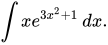
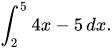
Find the antiderivatives:
- (a)
- (b)
| Foundations: |
|---|
| This problem requires Integration by substitution (u - sub): If is a differentiable functions whose range is in the domain of , then |
|
|
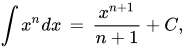
| We also need our power rule for integration: |
|



Solution:
| Step 1: |
|---|
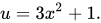
(a) Use a u-substitution with This means , or . After substitution we have
|
| (b) We need to use the power rule to find that |


| Step 2: |
|---|
| (a)
|
| (b) We just need to evaluate at the endpoints to finish the problem:
|


| Step 3: |
|---|
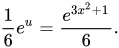
| (a) Now we need to substitute back into our original variables using our original substitution |
| to find |

| Step 4: |
|---|
| Since this integral is an indefinite integral we have to remember to add a constant at the end. |

| Final Answer: |
|---|
| (a)
|
| (b) 27 |
