Difference between revisions of "022 Exam 2 Sample B, Problem 3"
Jump to navigation
Jump to search
(Created page with "<span class="exam"> Find the derivative: <math style="vertical-align: -18%">f(x) \,=\, 2x^3e^{3x+5}</math>.") |
|||
| Line 1: | Line 1: | ||
| − | <span class="exam"> Find the derivative | + | <span class="exam"> Find the derivative of <math style="vertical-align: -18%">f(x) \,=\, 2x^3e^{3x+5}</math>. |
| + | |||
| + | |||
| + | {| class="mw-collapsible mw-collapsed" style = "text-align:left;" | ||
| + | !Foundations: | ||
| + | |- | ||
| + | |This problem requires several advanced rules of differentiation. In particular, you need | ||
| + | |- | ||
| + | |'''The Chain Rule:''' If <math style="vertical-align: -25%;">f</math> and <math style="vertical-align: -15%;">g</math> are differentiable functions, then | ||
| + | |- | ||
| + | |||
| + | |<br> <math>(f\circ g)'(x) = f'(g(x))\cdot g'(x).</math> | ||
| + | |- | ||
| + | |<br>'''The Product Rule:''' If <math style="vertical-align: -25%;">f</math> and <math style="vertical-align: -15%;">g</math> are differentiable functions, then | ||
| + | |- | ||
| + | |<br> <math>(fg)'(x) = f'(x)\cdot g(x)+f(x)\cdot g'(x).</math> | ||
| + | |- | ||
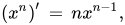
| + | |Additionally, we will need our power rule for differentiation: | ||
| + | |- | ||
| + | | | ||
| + | ::<math style="vertical-align: -21%;">\left(x^n\right)'\,=\,nx^{n-1},</math> for <math style="vertical-align: -25%;">n\neq 0</math>, | ||
| + | |- | ||
| + | |as well as the derivative of the exponential function, <math>e^x</math>: | ||
| + | |- | ||
| + | | | ||
| + | ::<math>\left(e^{f(x)}\right)'\,=\,\left(f(x)\right)'\cdot e^{f(x)}.</math> | ||
| + | |<br> | ||
| + | |} | ||
| + | |||
| + | '''Solution:''' | ||
| + | |||
| + | {| class="mw-collapsible mw-collapsed" style = "text-align:left;" | ||
| + | !Step 1: | ||
| + | |- | ||
| + | |We need to identify the composed functions in order to apply the chain rule. Note that if we set <math style="vertical-align: -21%">g(x)\,=\,\ln x</math>, and | ||
| + | |- | ||
| + | | | ||
| + | ::<math>f(x)\,=\,\frac{(x+5)(x-1)}{x},</math> | ||
| + | |- | ||
| + | |we then have  <math style="vertical-align: -21%">y\,=\,g\circ f(x)\,=\,g\left(f(x)\right).</math> | ||
| + | |} | ||
Revision as of 16:25, 15 May 2015
Find the derivative of .

| Foundations: | |
|---|---|
| This problem requires several advanced rules of differentiation. In particular, you need | |
| The Chain Rule: If and are differentiable functions, then | |
The Product Rule: If and are differentiable functions, then | |
| Additionally, we will need our power rule for differentiation: | |
| |
| as well as the derivative of the exponential function, : | |
|
|






Solution:
| Step 1: |
|---|
| We need to identify the composed functions in order to apply the chain rule. Note that if we set , and |
|
|
| we then have |


