Difference between revisions of "022 Exam 2 Sample A, Problem 2"
Jump to navigation
Jump to search
| Line 24: | Line 24: | ||
<math>\begin{array}{rcl} | <math>\begin{array}{rcl} | ||
\int y\, dx & = & \int3x^{2}-12x+8\, dx\\ | \int y\, dx & = & \int3x^{2}-12x+8\, dx\\ | ||
| + | \\ | ||
& = & 3\cdot \frac{x^3}{3}-12\cdot \frac{x^2}{2}+8x+C\\ | & = & 3\cdot \frac{x^3}{3}-12\cdot \frac{x^2}{2}+8x+C\\ | ||
| − | + | \\ | |
| + | & = & x^3-6x^2+8x+C.\end{array}</math> | ||
|- | |- | ||
|Do <u>'''not'''</u> forget the constant when evaluating an antiderivative (i.e., an integral without upper and lower bounds)! | |Do <u>'''not'''</u> forget the constant when evaluating an antiderivative (i.e., an integral without upper and lower bounds)! | ||
Revision as of 14:45, 15 May 2015
Find the antiderivative of

| Foundations: |
|---|
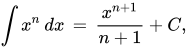
| We only require some fundamental rules for antiderivatives/integrals. We have the power rule: |
|
| Also, like derivatives, multiplication by a constant and addition/subtraction are respected by the antiderivative: |
|
|


| Solution: |
|---|
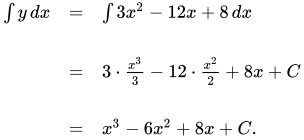
| We can apply the rules listed above to find |
|
|
| Do not forget the constant when evaluating an antiderivative (i.e., an integral without upper and lower bounds)! |
| Final Answer: |
|---|
|
|
