Difference between revisions of "009C Sample Midterm 3, Problem 5"
Jump to navigation
Jump to search
m |
m |
||
| Line 74: | Line 74: | ||
::<math>\left|a_{n}\right|\,=\,\left|\frac{(x+1)^{n}}{n^{2}}\right|\,=\,\frac{1}{n^{2}},</math> | ::<math>\left|a_{n}\right|\,=\,\left|\frac{(x+1)^{n}}{n^{2}}\right|\,=\,\frac{1}{n^{2}},</math> | ||
|- | |- | ||
| − | |which defines a p-series with <math style="vertical-align: - | + | |which defines a p-series with <math style="vertical-align: -15%">p=2</math>. Thus, the series defined by each boundary point is absolutely convergent (and therefore convergent), and the interval of convergence is <math style="vertical-align: -20%">[-2,0]</math>. |
|} | |} | ||
Revision as of 15:51, 27 April 2015
Find the radius of convergence and the interval of convergence of the series.
- (a) (6 points)

- (b) (6 points)



| Foundations: |
|---|
| When we are asked to find the radius of convergence, we are given a series where |
|
|
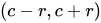
| where and are functions of and respectively, and is a constant (frequently zero). We need to find a bound (radius) on such that whenever , the ratio test |
|
|


Solution:
| (a): |
|---|
| We need to choose a radius such that whenever , |
|
|
| In this case, the radius is 1, and the interval will be centered at 0. We then need to take a look at the boundary points. If then |
|
|
| so the series is an alternating harmonic series which converges. On the other hand, if then |
|
|
| a standard harmonic series which does not converge. Thus, the interval of convergence is . |


![{\displaystyle (-1,1]}](https://wikimedia.org/api/rest_v1/media/math/render/svg/aeb867c952ef44df473d94b1bf180104285d3259)
| (b): |
|---|
| We need to choose a radius such that whenever , |
|
|
| In this case, the radius is 1, and the interval will be centered at , or when . We then need to take a look at the boundary points. If or , then |
|
|
| which defines a p-series with . Thus, the series defined by each boundary point is absolutely convergent (and therefore convergent), and the interval of convergence is . |


![{\displaystyle [-2,0]}](https://wikimedia.org/api/rest_v1/media/math/render/svg/71a51abb57b43d885053eed14d7fda7aff8e45b2)
| Final Answer: |
|---|
| For (a), the radius is 1 and the interval of convergence is . |
| For (b), the radius is also 1, but the interval of convergence is . |