Difference between revisions of "009C Sample Midterm 3, Problem 3"
(Created page with "<span class="exam">Test if each the following series converges or diverges. Give reasons and clearly state if you are using any standard test. ::<span class="exam">(a) (6 poi...") |
m |
||
| Line 76: | Line 76: | ||
it is convergent. By the limit comparison test, <math style="vertical-align: -90%">\sum_{n=2}^{\infty}\frac{\sqrt{n}}{n^{2}-3}</math> | it is convergent. By the limit comparison test, <math style="vertical-align: -90%">\sum_{n=2}^{\infty}\frac{\sqrt{n}}{n^{2}-3}</math> | ||
 is convergent. |  is convergent. | ||
| + | |} | ||
| + | {| class="mw-collapsible mw-collapsed" style = "text-align:left;" | ||
| + | !Final Answer: | ||
| + | |- | ||
| + | |Both series are convergent. | ||
|} | |} | ||
[[009C_Sample_Midterm_3|'''<u>Return to Sample Exam</u>''']] | [[009C_Sample_Midterm_3|'''<u>Return to Sample Exam</u>''']] | ||
Revision as of 12:59, 26 April 2015
Test if each the following series converges or diverges. Give reasons and clearly state if you are using any standard test.
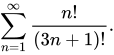
- (a) (6 points) Failed to parse (MathML with SVG or PNG fallback (recommended for modern browsers and accessibility tools): Invalid response ("Math extension cannot connect to Restbase.") from server "https://wikimedia.org/api/rest_v1/":): {\displaystyle {\displaystyle \sum_{n=1}^{\infty}}\,\frac{n!}{(3n+1)!}.}
- (b) (6 points) Failed to parse (MathML with SVG or PNG fallback (recommended for modern browsers and accessibility tools): Invalid response ("Math extension cannot connect to Restbase.") from server "https://wikimedia.org/api/rest_v1/":): {\displaystyle {\displaystyle \sum_{n=2}^{\infty}}\,\frac{\sqrt{n}}{n^{2}-3}.}
| Foundations: |
|---|
| Most of the time, if there are factorials in the terms of a series, you would use the |
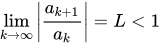
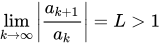
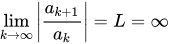
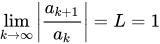
| Ratio Test. Let Failed to parse (MathML with SVG or PNG fallback (recommended for modern browsers and accessibility tools): Invalid response ("Math extension cannot connect to Restbase.") from server "https://wikimedia.org/api/rest_v1/":): {\displaystyle \sum_{k=1}^{\infty} a_{k}} be a series. Then: |
|
|
|
| This works well, as factorials cancel out many terms. For example, |
|
| On the other hand, something built mainly out of powers of Failed to parse (MathML with SVG or PNG fallback (recommended for modern browsers and accessibility tools): Invalid response ("Math extension cannot connect to Restbase.") from server "https://wikimedia.org/api/rest_v1/":): {\displaystyle n} may work well with the |
| Limit Comparison Test. Suppose Failed to parse (MathML with SVG or PNG fallback (recommended for modern browsers and accessibility tools): Invalid response ("Math extension cannot connect to Restbase.") from server "https://wikimedia.org/api/rest_v1/":): {\displaystyle \sum_{k=1}^{\infty} a_{k}} and Failed to parse (MathML with SVG or PNG fallback (recommended for modern browsers and accessibility tools): Invalid response ("Math extension cannot connect to Restbase.") from server "https://wikimedia.org/api/rest_v1/":): {\displaystyle \sum_{k=1}^{\infty} b_{k}} are series with positive terms. If Failed to parse (MathML with SVG or PNG fallback (recommended for modern browsers and accessibility tools): Invalid response ("Math extension cannot connect to Restbase.") from server "https://wikimedia.org/api/rest_v1/":): {\displaystyle \lim_{k\rightarrow\infty}\frac{a_{k}}{b_{k}}=c} where Failed to parse (MathML with SVG or PNG fallback (recommended for modern browsers and accessibility tools): Invalid response ("Math extension cannot connect to Restbase.") from server "https://wikimedia.org/api/rest_v1/":): {\displaystyle 0<c<\infty} , then either both series converge, or both series diverge. |
| In the case of a series built mainly out of powers, you would choose to compare it to a p-series. |
Solution:
| (a): |
|---|
| As mentioned in Foundations, we should use the ratio test. Note that |
|
| Thus, |
|
| so by the ratio test the series converges. |
| (b): |
|---|
| Here, we can use the limit comparison test. Let Failed to parse (MathML with SVG or PNG fallback (recommended for modern browsers and accessibility tools): Invalid response ("Math extension cannot connect to Restbase.") from server "https://wikimedia.org/api/rest_v1/":): {\displaystyle a_{n}=\frac{\sqrt{n}}{n^{2}-3}} , and let Failed to parse (MathML with SVG or PNG fallback (recommended for modern browsers and accessibility tools): Invalid response ("Math extension cannot connect to Restbase.") from server "https://wikimedia.org/api/rest_v1/":): {\displaystyle b_{n}=\frac{1}{n^{3/2}}.} Notice that the terms of Failed to parse (MathML with SVG or PNG fallback (recommended for modern browsers and accessibility tools): Invalid response ("Math extension cannot connect to Restbase.") from server "https://wikimedia.org/api/rest_v1/":): {\displaystyle a_{n}} are all positive, and |
Since Failed to parse (MathML with SVG or PNG fallback (recommended for modern browsers and accessibility tools): Invalid response ("Math extension cannot connect to Restbase.") from server "https://wikimedia.org/api/rest_v1/":): {\displaystyle \sum_{n=2}^{\infty}\frac{1}{n^{3/2}}} is a p-series with Failed to parse (MathML with SVG or PNG fallback (recommended for modern browsers and accessibility tools): Invalid response ("Math extension cannot connect to Restbase.") from server "https://wikimedia.org/api/rest_v1/":): {\displaystyle p>1,} it is convergent. By the limit comparison test, Failed to parse (MathML with SVG or PNG fallback (recommended for modern browsers and accessibility tools): Invalid response ("Math extension cannot connect to Restbase.") from server "https://wikimedia.org/api/rest_v1/":): {\displaystyle \sum_{n=2}^{\infty}\frac{\sqrt{n}}{n^{2}-3}} is convergent. |
| Final Answer: |
|---|
| Both series are convergent. |