Difference between revisions of "022 Exam 1 Sample A, Problem 6"
Jump to navigation
Jump to search

m |
m |
||
| Line 51: | Line 51: | ||
|- | |- | ||
|With units, we have that the ladder is sliding down the wall at <math style="vertical-align: -25%">-3/2</math>  feet per second. | |With units, we have that the ladder is sliding down the wall at <math style="vertical-align: -25%">-3/2</math>  feet per second. | ||
| + | |} | ||
{| class="mw-collapsible mw-collapsed" style = "text-align:left;" | {| class="mw-collapsible mw-collapsed" style = "text-align:left;" | ||
| − | |||
!Final Answer: | !Final Answer: | ||
|- | |- | ||
Revision as of 22:40, 12 April 2015

A 15-foot ladder is leaning against a house. The base of the ladder is pulled away from the house at a rate of 2 feet per second. How fast is the top of the ladder moving down the wall when the base of the ladder is 9 feet from the house.
| Foundations: |
|---|
| Like most geometric word problems, you should start with a picture. This will help you declare variables and write meaningful equation(s). In this case, we will have to use implicit differentiation to arrive at our related rate. |
Solution:
| Step 1: |
|---|
| Write the Basic Equation: From the picture, we can see that the ladder forms a right triangle with the wall and the ground, so we can treat our variables as |
|
|
| where is the height of the ladder on the wall, and is the distance between the wall and the base of the ladder. |


| Step 2: |
|---|
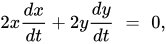
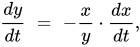
| Use Implicit Differentiation: We take the derivative of the equation from Step 1 to find |
|
|
| or |
|
|
| Step 3: |
|---|
| Evaluate and Solve: At the particular moment we care about, |
|
|
| From this, we can simply plug in to find |
|
|
| With units, we have that the ladder is sliding down the wall at feet per second. |



| Final Answer: |
|---|
| With units, we have that the ladder is sliding down the wall at feet per second. |