Difference between revisions of "022 Exam 1 Sample A, Problem 3"
Jump to navigation
Jump to search
(Created page with "<span class="exam">'''Problem 3.''' Given a function <math style="vertical-align: -40%;">g(x)=\frac{x+5}{x^{2}-25}</math> , :<span...") |
m |
||
| Line 58: | Line 58: | ||
|- | |- | ||
|where  <math style="vertical-align: 0%">0^{-}</math> can be thought of as "really small negative numbers approaching zero." Since the handed limits do not agree, the limit as x approaches 5 does not exist. | |where  <math style="vertical-align: 0%">0^{-}</math> can be thought of as "really small negative numbers approaching zero." Since the handed limits do not agree, the limit as x approaches 5 does not exist. | ||
| + | |} | ||
| + | |||
| + | {| class="mw-collapsible mw-collapsed" style = "text-align:left;" | ||
| + | !Final Answer: | ||
| + | |- | ||
| + | |'''(a): ''' <math style="vertical-align: -20%">f </math> is continuous on <math style="vertical-align: -25%">(-\infty ,-5)\cup (-5,5)\cup (5,\infty). </math> | ||
| + | |- | ||
| + | |'''(b): ''' <math style="vertical-align: -50%"> \lim_{x\rightarrow5}g(x)</math> does not exist. | ||
|} | |} | ||
[[022_Exam_1_Sample_A|'''<u>Return to Sample Exam</u>''']] | [[022_Exam_1_Sample_A|'''<u>Return to Sample Exam</u>''']] | ||
Revision as of 10:01, 12 April 2015
Problem 3. Given a function ,

- (a) Find the intervals where is continuous.

- (b). Find .

| Foundations: |
|---|
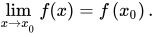
| A function is continuous at a point if |
|
|
| This can be viewed as saying the left and right hand limits exist, and are equal to the value of at . |


Solution:
| (a): |
|---|
| Note that |
|
|
| In order to be continuous at a point , must exist. However, attempting to plug in results in division by zero. Therefore, in interval notation, we have that is continuous on |
|
|



| (b): |
|---|
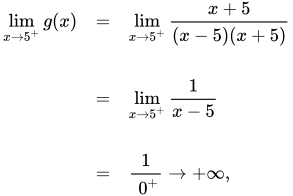
| Note that in order for the limit to exist, the limit from both the left and the right must be equal. But |
|
|
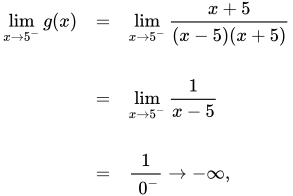
| while |
|
|
| where can be thought of as "really small negative numbers approaching zero." Since the handed limits do not agree, the limit as x approaches 5 does not exist. |

| Final Answer: |
|---|
| (a): is continuous on |
| (b): does not exist. |