Difference between revisions of "009A Sample Final A, Problem 3"
Jump to navigation
Jump to search
m |
m |
||
| Line 35: | Line 35: | ||
|A function <math style="vertical-align: -20%;">f</math> is continuous at a point <math style="vertical-align: -14%">x_0 </math> if | |A function <math style="vertical-align: -20%;">f</math> is continuous at a point <math style="vertical-align: -14%">x_0 </math> if | ||
|- | |- | ||
| − | | <math>\lim_{x\rightarrow | + | | <math>\lim_{x\rightarrow x_{_0}} f(x) = f\left(x_0\right).</math> |
|- | |- | ||
|This can be viewed as saying the left and right hand limits exist, and are equal to the value of <math style="vertical-align: -20%">f</math> at <math style="vertical-align: -14%">x_0</math>. For problems like these, where we are trying to find a particular value for  <math style="vertical-align: 0%;">C</math>, we can just set the two descriptions of the function to be equal at the value where the definition of <math style="vertical-align: -20%;">f</math> changes. | |This can be viewed as saying the left and right hand limits exist, and are equal to the value of <math style="vertical-align: -20%">f</math> at <math style="vertical-align: -14%">x_0</math>. For problems like these, where we are trying to find a particular value for  <math style="vertical-align: 0%;">C</math>, we can just set the two descriptions of the function to be equal at the value where the definition of <math style="vertical-align: -20%;">f</math> changes. | ||
Latest revision as of 09:33, 12 April 2015

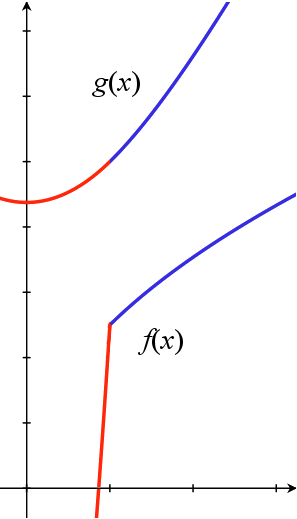
Both functions with constants chosen to provide continuity.
3. (Version I) Consider the following function:
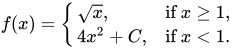
| (a) | Find a value of which makes continuous at |
| (b) | With your choice of , is differentiable at ? Use the definition of the derivative to motivate your answer. |


3. (Version II) Consider the following function:
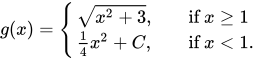
| (a) | Find a value of which makes continuous at |
| (b) | With your choice of , is differentiable at ? Use the definition of the derivative to motivate your answer. |
| Foundations: |
|---|
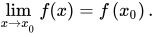
| A function is continuous at a point if |
| This can be viewed as saying the left and right hand limits exist, and are equal to the value of at . For problems like these, where we are trying to find a particular value for , we can just set the two descriptions of the function to be equal at the value where the definition of changes. |
| When we speak of differentiability at such a transition point, being "motivated by the definition of the derivative" really means acknowledging that the derivative is a limit, and for a limit to exist it must agree from the left and the right. This means we must show the derivatives agree for both the descriptions of at the transition point. |

Solution:
| Version I: |
|---|
| (a) For continuity, we evaluate both rules for the function at the transition point , set the results equal, and then solve for . Since we want |
| we can set , and the function will be continuous (the left and right hand limits agree, and equal the function's value at the point ).
(b) To test differentiability, we note that for , |
| while for , |
| Thus |
| but |
| Since the left and right hand limit do not agree, the derivative does not exist at the point . |





| Version II: |
|---|
| (a) Like Version I, we begin by setting the two functions equal. We want |
| so makes the function continuous. |
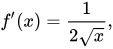
| (b) We again consider the derivative from each side of 1. For , |
| while for , |
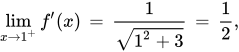
| Thus |
| and |
| Since the left and right hand limit do agree, the limit (which is the derivative) does exist at the point , and is differentiable at the required point. |