Difference between revisions of "022 Exam 1 Sample A, Problem 2"
Jump to navigation
Jump to search
(Created page with "<span style="font-size:135%"><font face=Times Roman>2. Use implicit differentiation to find <math style="vertical-align: -16%">dy/dx</math> at the point <math style="vertical-...") |
m |
||
| Line 5: | Line 5: | ||
!Foundations: | !Foundations: | ||
|- | |- | ||
| − | |When we use implicit differentiation, we combine the chain rule with the fact that <math style="vertical-align: -18%">y</math> is a function of <math style="vertical-align: 0%">x</math>, and could really be written as <math style="vertical-align: -25%">y(x).</math> Because of this, the derivative | + | |When we use implicit differentiation, we combine the chain rule with the fact that <math style="vertical-align: -18%">y</math> is a function of <math style="vertical-align: 0%">x</math>, and could really be written as <math style="vertical-align: -25%">y(x).</math> Because of this, the derivative of <math style="vertical-align:-21%">y^3</math> with respect to <math style="vertical-align: 0%">x</math> requires the chain rule, so |
|- | |- | ||
| <math>\frac{d}{dx}\left(y^{3}\right)=3y^{2}\cdot\frac{dy}{dt}.</math> | | <math>\frac{d}{dx}\left(y^{3}\right)=3y^{2}\cdot\frac{dy}{dt}.</math> | ||
Revision as of 22:46, 31 March 2015
2. Use implicit differentiation to find at the point on the curve defined by .


| Foundations: |
|---|
| When we use implicit differentiation, we combine the chain rule with the fact that is a function of , and could really be written as Because of this, the derivative of with respect to requires the chain rule, so |


Solution:
| Step 1: |
|---|
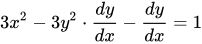
| First, we differentiate each term separately with respect to x to find that differentiates implicitly to |
| . |
| Step 2: |
|---|
| Since they don't ask for a general expression of , but rather a particular value at a particular point, we can plug in the values and to find |
| which is equivalent to . This solves to |




