Difference between revisions of "Math 22 Natural Exponential Functions"
Jump to navigation
Jump to search
| Line 47: | Line 47: | ||
|} | |} | ||
| + | ==Present Value== | ||
| + | |||
| + | <math>P=\frac{A}{(1+\frac{r}{n})^{n t}}</math> | ||
[[Math_22| '''Return to Topics Page''']] | [[Math_22| '''Return to Topics Page''']] | ||
'''This page were made by [[Contributors|Tri Phan]]''' | '''This page were made by [[Contributors|Tri Phan]]''' | ||
Revision as of 07:08, 11 August 2020
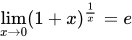
Limit Definition of

The irrational number is defined to be the limit:

Compound Interest
Let be the amount deposited, the number of years, the balance, and the annual interest rate (in decimal form). 1. Compounded times per year: 2. Compounded continuously:


Exercises Find the balance in an account when $3000 is deposited for 10 years at an interest rate of 4%, compounded as follows.
a) Quarterly
| Solution: |
|---|

a) Annually
| Solution: |
|---|

a) Monthly
| Solution: |
|---|

a) Daily
| Solution: |
|---|

a) Continuously
| Solution: |
|---|

Present Value

This page were made by Tri Phan