Difference between revisions of "Math 22 Chain Rule"
Jump to navigation
Jump to search
| Line 29: | Line 29: | ||
|<math>=100(x^2+1)^{99} (2x)</math> | |<math>=100(x^2+1)^{99} (2x)</math> | ||
|} | |} | ||
| + | |||
| + | ==The General Power Rule== | ||
| + | If <math>y=[u(x)]^n</math>, where <math>u</math> is a differentiable function of <math>x</math> | ||
| + | and <math>n</math> is a real number, then | ||
| + | |||
| + | <math>\frac{d}{dx}[u^n]=n\cdot u^{n-1}\cdot u'</math> | ||
[[Math_22| '''Return to Topics Page''']] | [[Math_22| '''Return to Topics Page''']] | ||
'''This page were made by [[Contributors|Tri Phan]]''' | '''This page were made by [[Contributors|Tri Phan]]''' | ||
Latest revision as of 06:16, 23 July 2020
The Chain Rule
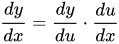
If is a differentiable function of and is a differentiable function of , then is a differentiable function of and In another word,


![{\displaystyle {\frac {d}{dx}}[f(g(x))]=f'(g(x))\cdot g'(x)}](https://wikimedia.org/api/rest_v1/media/math/render/svg/0fe337c7649f42de72e6de2b1ef3d88949b95f90)
Example: Find derivative of
1)

| Solution: |
|---|

![{\displaystyle f'(x)={\frac {1}{2}}\cdot (x^{2}+3x-4)^{({\frac {1}{2}}-1)}{\frac {d}{dx}}[x^{2}+3x-4]}](https://wikimedia.org/api/rest_v1/media/math/render/svg/e86c1609190d682e59f2403038bd4893af06e01a)

2)

| Solution: |
|---|
![{\displaystyle f'(x)=100(x^{2}+1)^{99}{\frac {d}{dx}}[x^{2}+1]}](https://wikimedia.org/api/rest_v1/media/math/render/svg/a477c6061cfe30d0aa8263d0433d42b905ec5f44)

The General Power Rule
If , where is a differentiable function of and is a real number, then
![{\displaystyle y=[u(x)]^{n}}](https://wikimedia.org/api/rest_v1/media/math/render/svg/1c059fac9a08c53663c6fe92122492ad43eb7903)

![{\displaystyle {\frac {d}{dx}}[u^{n}]=n\cdot u^{n-1}\cdot u'}](https://wikimedia.org/api/rest_v1/media/math/render/svg/7b74c36d18978165f297d197ce2f769a90a1f72e)
This page were made by Tri Phan