Difference between revisions of "009A Sample Final A, Problem 1"
Jump to navigation
Jump to search
| Line 69: | Line 69: | ||
| <math>=\,-1.</math><br> | | <math>=\,-1.</math><br> | ||
|} | |} | ||
| + | |||
| + | {| class="mw-collapsible mw-collapsed" style = "text-align:left;" | ||
| + | !Part (c): | ||
| + | |- | ||
| + | |Here, both the numerator and denominator go to zero as <math style="vertical-align: 0%;">x</math> goes to 3, so we have an indeterminate form. We can choose to either apply l'Hôpital's Rule, or use the conjugate of the denominator. Using the conjugate, we find | ||
| + | |- | ||
| + | | <math>\lim_{x\rightarrow3}\frac{x-3}{\sqrt{x+1}-2}\cdot\frac{\sqrt{x+1}+2}{\sqrt{x+1}+2}\,=\,\lim_{x\rightarrow3}\frac{(x-3)(\sqrt{x+1}+2)}{\left(\sqrt{x+1}\right)^{2}-\left(2\right)^{2}}</math> | ||
| + | |- | ||
| + | | <math>=\,\lim_{x\rightarrow3}\frac{(x-3)(\sqrt{x+1}+2)}{x+1-4}</math> | ||
| + | |- | ||
| + | |  | <math>=\,\lim_{x\rightarrow3}\frac{(x-3)(\sqrt{x+1}+2)}{x-3}</math> | ||
| + | |- | ||
| + | | <math>=\,\lim_{x\rightarrow3}\sqrt{x+1}+2</math> | ||
| + | |- | ||
| + | | <math>=\,4.</math> | ||
| + | |- | ||
| + | |Alternatively, we can apply l'Hôpital's Rule: | ||
| + | |- | ||
| + | | <math>\lim_{x\rightarrow3}\frac{x-3}{\sqrt{x+1}-2}\,\,\overset{l'H}{=}\,\,\lim_{x\rightarrow3}\frac{1}{{\displaystyle \frac{1}{2}\cdot\frac{1}{\sqrt{x+1}}}}\,=\,\frac{1}{\frac{1}{2}\cdot\frac{1}{2}}\,=\,4.</math> | ||
| + | |||
| + | |} | ||
| + | |||
| + | |||
[[009A_Sample_Final_A|'''<u>Return to Sample Exam</u>''']] | [[009A_Sample_Final_A|'''<u>Return to Sample Exam</u>''']] | ||
Revision as of 11:57, 27 March 2015
1. Find the following limits:
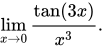
(a)
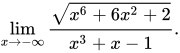
(b)
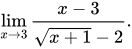
(c)
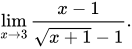
(d)
(e)
| Foundations: |
|---|
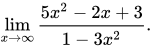
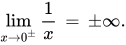
| When evaluating limits of rational functions, the first idea to try is to simply plug in the limit. In addition to this, we must consider that as a limit, |
| and |
| In the latter case, the sign matters. Unfortunately, most (but not all) exam questions require more work. Many of them will evaluate to an indeterminate form, or something of the form |
or |
In this case, here are several approaches to try: |
|
| Note that the first requirement in l'Hôpital's Rule is that the fraction must be an indeterminate form. This should be shown in your answer for any exam question. |




![{\displaystyle \left({\sqrt[{3}]{x}}-1\right)\left(\left({\sqrt[{3}]{x}}\right)^{2}+{\sqrt[{3}]{x}}+1\right)}](https://wikimedia.org/api/rest_v1/media/math/render/svg/e0afb547cc668e424337a1effff0c87319c32d75)





| Part (a): |
|---|
| Note that both the numerator and denominator are continuous functions, and that the limit of each is 0 as Failed to parse (MathML with SVG or PNG fallback (recommended for modern browsers and accessibility tools): Invalid response ("Math extension cannot connect to Restbase.") from server "https://wikimedia.org/api/rest_v1/":): {\displaystyle x} approaches 0. This is an indeterminate form, and we can apply l'Hôpital's Rule: |
| Failed to parse (MathML with SVG or PNG fallback (recommended for modern browsers and accessibility tools): Invalid response ("Math extension cannot connect to Restbase.") from server "https://wikimedia.org/api/rest_v1/":): {\displaystyle \lim_{x\rightarrow0}\frac{\tan(3x)}{x^{3}}\,\,\overset{l'H}{=}\,\,\lim_{x\rightarrow0}\frac{\sec^{2}(3x)\cdot3}{3x^{2}}\,=\,\lim_{x\rightarrow0}\frac{3}{3x^{2}}.} |
| Now, Failed to parse (MathML with SVG or PNG fallback (recommended for modern browsers and accessibility tools): Invalid response ("Math extension cannot connect to Restbase.") from server "https://wikimedia.org/api/rest_v1/":): {\displaystyle x^2}
can only be positive, so our limit can also only be positive. Thus, the limit is Failed to parse (MathML with SVG or PNG fallback (recommended for modern browsers and accessibility tools): Invalid response ("Math extension cannot connect to Restbase.") from server "https://wikimedia.org/api/rest_v1/":): {\displaystyle +\infty}
. |
| Part (b): |
|---|
| In the case of limits at infinity, we can apply one other method. We can multiply our original argument by a fraction equal to one, and then can evaluate each term separately. Since we only need to consider values which are negative, we have that |
| Failed to parse (MathML with SVG or PNG fallback (recommended for modern browsers and accessibility tools): Invalid response ("Math extension cannot connect to Restbase.") from server "https://wikimedia.org/api/rest_v1/":): {\displaystyle -\,\frac{\sqrt{\frac{1}{x^{6}}}}{\frac{1}{x^{3}}}\,=\,1,} |
| since for negative values of Failed to parse (MathML with SVG or PNG fallback (recommended for modern browsers and accessibility tools): Invalid response ("Math extension cannot connect to Restbase.") from server "https://wikimedia.org/api/rest_v1/":): {\displaystyle x} , |
| Failed to parse (MathML with SVG or PNG fallback (recommended for modern browsers and accessibility tools): Invalid response ("Math extension cannot connect to Restbase.") from server "https://wikimedia.org/api/rest_v1/":): {\displaystyle \sqrt{\frac{1}{x^{6}}}\,=\,\left|\frac{1}{x^{3}}\right|\,=\,-\,\frac{1}{x^{3}}.} |
| This means that |
| Failed to parse (MathML with SVG or PNG fallback (recommended for modern browsers and accessibility tools): Invalid response ("Math extension cannot connect to Restbase.") from server "https://wikimedia.org/api/rest_v1/":): {\displaystyle \lim_{x\rightarrow-\infty}\frac{\sqrt{x^{6}+6x^{2}+2}}{x^{3}+x-1}\,=\,\lim_{x\rightarrow-\infty}\frac{\sqrt{x^{6}+6x^{2}+2}}{x^{3}+x-1}\cdot\left(-\,\frac{\sqrt{\frac{1}{x^{6}}}}{\frac{1}{x^{3}}}\right)} |
| Failed to parse (MathML with SVG or PNG fallback (recommended for modern browsers and accessibility tools): Invalid response ("Math extension cannot connect to Restbase.") from server "https://wikimedia.org/api/rest_v1/":): {\displaystyle =\,\lim_{x\rightarrow-\infty}-\,\frac{\sqrt{1+\frac{6x^{2}}{x^{6}}+\frac{2}{x^{6}}}}{1+\frac{x}{x^{3}}+\frac{1}{x}}} |
| Failed to parse (MathML with SVG or PNG fallback (recommended for modern browsers and accessibility tools): Invalid response ("Math extension cannot connect to Restbase.") from server "https://wikimedia.org/api/rest_v1/":): {\displaystyle =\,\lim_{x\rightarrow-\infty}-\,\frac{\sqrt{1+\frac{6}{x^{4}}+\frac{2}{x^{6}}}}{1+\frac{1}{x^{2}}+\frac{1}{x}}} |
| Failed to parse (MathML with SVG or PNG fallback (recommended for modern browsers and accessibility tools): Invalid response ("Math extension cannot connect to Restbase.") from server "https://wikimedia.org/api/rest_v1/":): {\displaystyle =\,-\,\frac{\sqrt{1+0+0}}{1+0+0}} |
| Failed to parse (MathML with SVG or PNG fallback (recommended for modern browsers and accessibility tools): Invalid response ("Math extension cannot connect to Restbase.") from server "https://wikimedia.org/api/rest_v1/":): {\displaystyle =\,-1.}
|
| Part (c): |
|---|
| Here, both the numerator and denominator go to zero as Failed to parse (MathML with SVG or PNG fallback (recommended for modern browsers and accessibility tools): Invalid response ("Math extension cannot connect to Restbase.") from server "https://wikimedia.org/api/rest_v1/":): {\displaystyle x} goes to 3, so we have an indeterminate form. We can choose to either apply l'Hôpital's Rule, or use the conjugate of the denominator. Using the conjugate, we find |
| Failed to parse (MathML with SVG or PNG fallback (recommended for modern browsers and accessibility tools): Invalid response ("Math extension cannot connect to Restbase.") from server "https://wikimedia.org/api/rest_v1/":): {\displaystyle \lim_{x\rightarrow3}\frac{x-3}{\sqrt{x+1}-2}\cdot\frac{\sqrt{x+1}+2}{\sqrt{x+1}+2}\,=\,\lim_{x\rightarrow3}\frac{(x-3)(\sqrt{x+1}+2)}{\left(\sqrt{x+1}\right)^{2}-\left(2\right)^{2}}} |
| Failed to parse (MathML with SVG or PNG fallback (recommended for modern browsers and accessibility tools): Invalid response ("Math extension cannot connect to Restbase.") from server "https://wikimedia.org/api/rest_v1/":): {\displaystyle =\,\lim_{x\rightarrow3}\frac{(x-3)(\sqrt{x+1}+2)}{x+1-4}} |
| Failed to parse (MathML with SVG or PNG fallback (recommended for modern browsers and accessibility tools): Invalid response ("Math extension cannot connect to Restbase.") from server "https://wikimedia.org/api/rest_v1/":): {\displaystyle =\,\lim_{x\rightarrow3}\frac{(x-3)(\sqrt{x+1}+2)}{x-3}} |
| Failed to parse (MathML with SVG or PNG fallback (recommended for modern browsers and accessibility tools): Invalid response ("Math extension cannot connect to Restbase.") from server "https://wikimedia.org/api/rest_v1/":): {\displaystyle =\,\lim_{x\rightarrow3}\sqrt{x+1}+2} |
| Failed to parse (MathML with SVG or PNG fallback (recommended for modern browsers and accessibility tools): Invalid response ("Math extension cannot connect to Restbase.") from server "https://wikimedia.org/api/rest_v1/":): {\displaystyle =\,4.} |
| Alternatively, we can apply l'Hôpital's Rule: |
| Failed to parse (MathML with SVG or PNG fallback (recommended for modern browsers and accessibility tools): Invalid response ("Math extension cannot connect to Restbase.") from server "https://wikimedia.org/api/rest_v1/":): {\displaystyle \lim_{x\rightarrow3}\frac{x-3}{\sqrt{x+1}-2}\,\,\overset{l'H}{=}\,\,\lim_{x\rightarrow3}\frac{1}{{\displaystyle \frac{1}{2}\cdot\frac{1}{\sqrt{x+1}}}}\,=\,\frac{1}{\frac{1}{2}\cdot\frac{1}{2}}\,=\,4.} |