Difference between revisions of "007A Sample Midterm 1, Problem 2 Detailed Solution"
Jump to navigation
Jump to search
(Created page with "<span class="exam">Consider the following function <math style="vertical-align: -5px"> f:</math> ::<math>f(x) = \left\{ \begin{array}{lr} x^2 & \text{if }x...") |
|||
| Line 15: | Line 15: | ||
<span class="exam">(d) Is <math style="vertical-align: -5px">f</math> continuous at <math style="vertical-align: -1px">x=1?</math> Briefly explain. | <span class="exam">(d) Is <math style="vertical-align: -5px">f</math> continuous at <math style="vertical-align: -1px">x=1?</math> Briefly explain. | ||
| − | + | <hr> | |
| − | |||
{| class="mw-collapsible mw-collapsed" style = "text-align:left;" | {| class="mw-collapsible mw-collapsed" style = "text-align:left;" | ||
| − | ! | + | !Background Information: |
|- | |- | ||
|'''1.''' If <math style="vertical-align: -15px">\lim_{x\rightarrow a^-} f(x)=\lim_{x\rightarrow a^+} f(x)=c,</math> | |'''1.''' If <math style="vertical-align: -15px">\lim_{x\rightarrow a^-} f(x)=\lim_{x\rightarrow a^+} f(x)=c,</math> | ||
| Line 54: | Line 53: | ||
<math>\begin{array}{rcl} | <math>\begin{array}{rcl} | ||
\displaystyle{\lim_{x\rightarrow 1^-} f(x)} & = & \displaystyle{\lim_{x\rightarrow 1^-} x^2}\\ | \displaystyle{\lim_{x\rightarrow 1^-} f(x)} & = & \displaystyle{\lim_{x\rightarrow 1^-} x^2}\\ | ||
| − | |||
| − | |||
&&\\ | &&\\ | ||
& = & \displaystyle{1^2}\\ | & = & \displaystyle{1^2}\\ | ||
| Line 84: | Line 81: | ||
<math>\begin{array}{rcl} | <math>\begin{array}{rcl} | ||
\displaystyle{\lim_{x\rightarrow 1^+} f(x)} & = & \displaystyle{\lim_{x\rightarrow 1^+} \sqrt{x}}\\ | \displaystyle{\lim_{x\rightarrow 1^+} f(x)} & = & \displaystyle{\lim_{x\rightarrow 1^+} \sqrt{x}}\\ | ||
| − | |||
| − | |||
&&\\ | &&\\ | ||
& = & \displaystyle{\sqrt{1}}\\ | & = & \displaystyle{\sqrt{1}}\\ | ||
Latest revision as of 11:28, 5 January 2018
Consider the following function

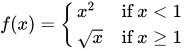
(a) Find

(b) Find

(c) Find

(d) Is continuous at Briefly explain.


| Background Information: |
|---|
| 1. If |
| then |
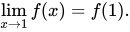
| 2. is continuous at if |




Solution:
(a)
| Step 1: |
|---|
| Notice that we are calculating a left hand limit. |
| Thus, we are looking at values of that are smaller than |
| Using the definition of we have |


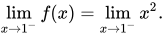
| Step 2: |
|---|
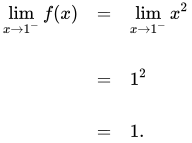
| Now, we have |
|
|
(b)
| Step 1: |
|---|
| Notice that we are calculating a right hand limit. |
| Thus, we are looking at values of that are bigger than |
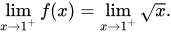
| Using the definition of we have |
| Step 2: |
|---|
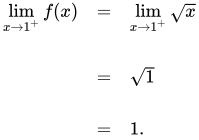
| Now, we have |
|
|
(c)
| Step 1: |
|---|
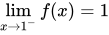
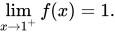
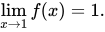
| From (a) and (b), we have |
| and |
| Step 2: |
|---|
| Since |
| we have |

(d)
| Step 1: |
|---|
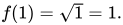
| From (c), we have |
| Also, |
| Step 2: |
|---|
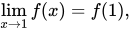
| Since |
| is continuous at |

| Final Answer: |
|---|
| (a) |
| (b) |
| (c) |
| (d) is continuous at since |