|
|
| (3 intermediate revisions by the same user not shown) |
| Line 1: |
Line 1: |
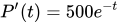
| − | <span class="exam">Evaluate the indefinite and definite integrals. | + | <span class="exam"> A population grows at a rate |
| | | | |
| − | ::<span class="exam">a) <math>\int x^2 e^x~dx</math> | + | ::<math>P'(t)=500e^{-t}</math> |
| − | ::<span class="exam">b) <math>\int_{1}^{e} x^3\ln x~dx</math>
| |
| | | | |
| | + | <span class="exam">where <math style="vertical-align: -5px">P(t)</math> is the population after <math style="vertical-align: 0px">t</math> months. |
| | | | |
| − | {| class="mw-collapsible mw-collapsed" style = "text-align:left;"
| + | <span class="exam">(a) Find a formula for the population size after <math style="vertical-align: 0px">t</math> months, given that the population is <math style="vertical-align: 0px">2000</math> at <math style="vertical-align: 0px">t=0.</math> |
| − | !Foundations:
| |
| − | |-
| |
| − | |'''1.''' Integration by parts tells us that <math style="vertical-align: -12px">\int u~dv=uv-\int v~du.</math>
| |
| − | |-
| |
| − | |'''2.''' How would you integrate <math style="vertical-align: -12px">\int x\ln x~dx?</math>
| |
| − | |-
| |
| − | |
| |
| − | ::You could use integration by parts.
| |
| − | |-
| |
| − | |
| |
| − | ::Let <math style="vertical-align: -1px">u=\ln x</math> and <math style="vertical-align: 0px">dv=x~dx.</math> Then, <math style="vertical-align: -13px">du=\frac{1}{x}dx</math> and <math style="vertical-align: -12px">v=\frac{x^2}{2}.</math>
| |
| − | |-
| |
| − | |
| |
| − | ::Thus, <math style="vertical-align: -15px">\int x\ln x~dx\,=\,\frac{x^2\ln x}{2}-\int \frac{x}{2}~dx\,=\,\frac{x^2\ln x}{2}-\frac{x^2}{4}+C.</math>
| |
| − | |}
| |
| | | | |
| − | '''Solution:''' | + | <span class="exam">(b) Use your answer to part (a) to find the size of the population after one month. |
| | + | <hr> |
| | + | [[009B Sample Midterm 1, Problem 3 Solution|'''<u>Solution</u>''']] |
| | | | |
| − | '''(a)'''
| |
| − | {| class="mw-collapsible mw-collapsed" style = "text-align:left;"
| |
| − | !Step 1:
| |
| − | |-
| |
| − | |We proceed using integration by parts. Let <math style="vertical-align: 0px">u=x^2</math> and <math style="vertical-align: 0px">dv=e^xdx.</math> Then, <math style="vertical-align: 0px">du=2xdx</math> and <math style="vertical-align: 0px">v=e^x.</math>
| |
| − | |-
| |
| − | |Therefore, we have
| |
| − | |-
| |
| − | |
| |
| − | ::<math style="vertical-align: -12px">\int x^2 e^x~dx=x^2e^x-\int 2xe^x~dx.</math>
| |
| − | |}
| |
| | | | |
| − | {| class="mw-collapsible mw-collapsed" style = "text-align:left;"
| + | [[009B Sample Midterm 1, Problem 3 Detailed Solution|'''<u>Detailed Solution</u>''']] |
| − | !Step 2:
| |
| − | |-
| |
| − | |Now, we need to use integration by parts again. Let <math style="vertical-align: 0px">u=2x</math> and <math style="vertical-align: 0px">dv=e^xdx.</math> Then, <math style="vertical-align: 0px">du=2dx</math> and <math style="vertical-align: 0px">v=e^x.</math> | |
| − | |-
| |
| − | |Building on the previous step, we have
| |
| − | |-
| |
| − | |
| |
| − | ::<math>\begin{array}{rcl}
| |
| − | \displaystyle{\int x^2 e^x~dx} & = & \displaystyle{x^2e^x-\bigg(2xe^x-\int 2e^x~dx\bigg)}\\
| |
| − | &&\\
| |
| − | & = & \displaystyle{x^2e^x-2xe^x+2e^x+C.}\\
| |
| − | \end{array}</math>
| |
| − | |}
| |
| | | | |
| − | '''(b)'''
| |
| − | {| class="mw-collapsible mw-collapsed" style = "text-align:left;"
| |
| − | !Step 1:
| |
| − | |-
| |
| − | |We proceed using integration by parts. Let <math style="vertical-align: -1px">u=\ln x</math> and <math style="vertical-align: 0px">dv=x^3dx.</math> Then, <math style="vertical-align: -13px">du=\frac{1}{x}dx</math> and <math style="vertical-align: -14px">v=\frac{x^4}{4}.</math>
| |
| − | |-
| |
| − | |Therefore, we have
| |
| − | |-
| |
| − | |
| |
| − | ::<math>\begin{array}{rcl}
| |
| − | \displaystyle{\int_{1}^{e} x^3\ln x~dx} & = & \displaystyle{\left.\ln x \bigg(\frac{x^4}{4}\bigg)\right|_{1}^{e}-\int_1^e \frac{x^3}{4}~dx }\\
| |
| − | &&\\
| |
| − | & = & \displaystyle{\left.\ln x \bigg(\frac{x^4}{4}\bigg)-\frac{x^4}{16}\right|_{1}^{e}.}\\
| |
| − | \end{array}</math>
| |
| − | |}
| |
| | | | |
| − | {| class="mw-collapsible mw-collapsed" style = "text-align:left;"
| |
| − | !Step 2:
| |
| − | |-
| |
| − | |Now, we evaluate to get
| |
| − | |-
| |
| − | |
| |
| − | ::<math>\begin{array}{rcl}
| |
| − | \displaystyle{\int_{1}^{e} x^3\ln x~dx} & = & \displaystyle{\bigg((\ln e) \frac{e^4}{4}-\frac{e^4}{16}\bigg)-\bigg((\ln 1) \frac{1^4}{4}-\frac{1^4}{16}\bigg)}\\
| |
| − | &&\\
| |
| − | & = & \displaystyle{\frac{e^4}{4}-\frac{e^4}{16}+\frac{1}{16}}\\
| |
| − | &&\\
| |
| − | & = & \displaystyle{\frac{3e^4+1}{16}.}\\
| |
| − | \end{array}</math>
| |
| − | |}
| |
| − |
| |
| − | {| class="mw-collapsible mw-collapsed" style = "text-align:left;"
| |
| − | !Final Answer:
| |
| − | |-
| |
| − | |'''(a)''' <math>x^2e^x-2xe^x+2e^x+C</math>
| |
| − | |-
| |
| − | |'''(b)''' <math>\frac{3e^4+1}{16}</math>
| |
| − | |}
| |
| | [[009B_Sample_Midterm_1|'''<u>Return to Sample Exam</u>''']] | | [[009B_Sample_Midterm_1|'''<u>Return to Sample Exam</u>''']] |
A population grows at a rate

where Failed to parse (MathML with SVG or PNG fallback (recommended for modern browsers and accessibility tools): Invalid response ("Math extension cannot connect to Restbase.") from server "https://wikimedia.org/api/rest_v1/":): {\displaystyle P(t)}
is the population after Failed to parse (MathML with SVG or PNG fallback (recommended for modern browsers and accessibility tools): Invalid response ("Math extension cannot connect to Restbase.") from server "https://wikimedia.org/api/rest_v1/":): {\displaystyle t}
months.
(a) Find a formula for the population size after Failed to parse (MathML with SVG or PNG fallback (recommended for modern browsers and accessibility tools): Invalid response ("Math extension cannot connect to Restbase.") from server "https://wikimedia.org/api/rest_v1/":): {\displaystyle t}
months, given that the population is Failed to parse (MathML with SVG or PNG fallback (recommended for modern browsers and accessibility tools): Invalid response ("Math extension cannot connect to Restbase.") from server "https://wikimedia.org/api/rest_v1/":): {\displaystyle 2000}
at Failed to parse (MathML with SVG or PNG fallback (recommended for modern browsers and accessibility tools): Invalid response ("Math extension cannot connect to Restbase.") from server "https://wikimedia.org/api/rest_v1/":): {\displaystyle t=0.}
(b) Use your answer to part (a) to find the size of the population after one month.
Solution
Detailed Solution
Return to Sample Exam