Difference between revisions of "009C Sample Midterm 2, Problem 5"
| Line 45: | Line 45: | ||
\displaystyle{\lim_{n\rightarrow \infty} \bigg| \frac{c_{n+1}x^{n+1}}{c_nx^n}\bigg|} & = & \displaystyle{\lim_{n\rightarrow \infty} \bigg|\frac{c_{n+1}x}{c_n}\bigg|}\\ | \displaystyle{\lim_{n\rightarrow \infty} \bigg| \frac{c_{n+1}x^{n+1}}{c_nx^n}\bigg|} & = & \displaystyle{\lim_{n\rightarrow \infty} \bigg|\frac{c_{n+1}x}{c_n}\bigg|}\\ | ||
&&\\ | &&\\ | ||
| − | & = & \displaystyle{|x|\lim_{n\rightarrow \infty}\frac{c_{n+1}}{c_n}.} | + | & = & \displaystyle{|x|\lim_{n\rightarrow \infty}\bigg(\frac{c_{n+1}}{c_n}\bigg).} |
\end{array}</math> | \end{array}</math> | ||
|- | |- | ||
|Since the radius of convergence of the series <math style="vertical-align: -19px">\sum_{n=0}^\infty c_nx^n</math> is <math style="vertical-align: -5px">R,</math> we have | |Since the radius of convergence of the series <math style="vertical-align: -19px">\sum_{n=0}^\infty c_nx^n</math> is <math style="vertical-align: -5px">R,</math> we have | ||
|- | |- | ||
| − | | <math>R=\frac{1}{\displaystyle{\lim_{n\rightarrow \infty} \frac{c_{n+1}}{c_n}}}.</math> | + | | <math>R=\frac{1}{\displaystyle{\lim_{n\rightarrow \infty} \bigg(\frac{c_{n+1}}{c_n}\bigg)}}.</math> |
|} | |} | ||
| Line 63: | Line 63: | ||
\displaystyle{\lim_{n\rightarrow \infty} \bigg| \frac{c_{n+1}2^nx^{n+1}}{c_n2^{n+1}x^n}\bigg|} & = & \displaystyle{\lim_{n\rightarrow \infty} \bigg|\frac{c_{n+1}x}{2c_n}\bigg|}\\ | \displaystyle{\lim_{n\rightarrow \infty} \bigg| \frac{c_{n+1}2^nx^{n+1}}{c_n2^{n+1}x^n}\bigg|} & = & \displaystyle{\lim_{n\rightarrow \infty} \bigg|\frac{c_{n+1}x}{2c_n}\bigg|}\\ | ||
&&\\ | &&\\ | ||
| − | & = & \displaystyle{\frac{|x|}{2}\lim_{n\rightarrow \infty}\frac{c_{n+1}}{c_n}.} | + | & = & \displaystyle{\frac{|x|}{2}\lim_{n\rightarrow \infty}\bigg(\frac{c_{n+1}}{c_n}\bigg).} |
\end{array}</math> | \end{array}</math> | ||
|- | |- | ||
|Hence, the radius of convergence of this power series is | |Hence, the radius of convergence of this power series is | ||
|- | |- | ||
| − | | <math>\frac{2}{\displaystyle{\lim_{n\rightarrow \infty} \frac{c_{n+1}}{c_n}}}=2R.</math> | + | | <math>\frac{2}{\displaystyle{\lim_{n\rightarrow \infty} \bigg(\frac{c_{n+1}}{c_n}\bigg)}}=2R.</math> |
|- | |- | ||
|Therefore, this power series converges. | |Therefore, this power series converges. | ||
| Line 89: | Line 89: | ||
\displaystyle{\lim_{n\rightarrow \infty} \bigg| \frac{c_{n+1}x^{n+1}}{c_nx^n}\bigg|} & = & \displaystyle{\lim_{n\rightarrow \infty} \bigg|\frac{c_{n+1}x}{c_n}\bigg|}\\ | \displaystyle{\lim_{n\rightarrow \infty} \bigg| \frac{c_{n+1}x^{n+1}}{c_nx^n}\bigg|} & = & \displaystyle{\lim_{n\rightarrow \infty} \bigg|\frac{c_{n+1}x}{c_n}\bigg|}\\ | ||
&&\\ | &&\\ | ||
| − | & = & \displaystyle{|x|\lim_{n\rightarrow \infty}\frac{c_{n+1}}{c_n}.} | + | & = & \displaystyle{|x|\lim_{n\rightarrow \infty}\bigg(\frac{c_{n+1}}{c_n}\bigg).} |
\end{array}</math> | \end{array}</math> | ||
|- | |- | ||
|Since the radius of convergence of the series <math style="vertical-align: -19px">\sum_{n=0}^\infty c_nx^n</math> is <math style="vertical-align: -5px">R,</math> we have | |Since the radius of convergence of the series <math style="vertical-align: -19px">\sum_{n=0}^\infty c_nx^n</math> is <math style="vertical-align: -5px">R,</math> we have | ||
|- | |- | ||
| − | | <math>R=\frac{1}{\displaystyle{\lim_{n\rightarrow \infty} \frac{c_{n+1}}{c_n}}}.</math> | + | | <math>R=\frac{1}{\displaystyle{\lim_{n\rightarrow \infty} \bigg(\frac{c_{n+1}}{c_n}\bigg)}}.</math> |
|} | |} | ||
| Line 107: | Line 107: | ||
\displaystyle{\lim_{n\rightarrow \infty} \bigg| \frac{c_{n+1}(-x)^{n+1}}{c_n(-x)^n}\bigg|} & = & \displaystyle{\lim_{n\rightarrow \infty} \bigg|\frac{c_{n+1}(-x)}{c_n}\bigg|}\\ | \displaystyle{\lim_{n\rightarrow \infty} \bigg| \frac{c_{n+1}(-x)^{n+1}}{c_n(-x)^n}\bigg|} & = & \displaystyle{\lim_{n\rightarrow \infty} \bigg|\frac{c_{n+1}(-x)}{c_n}\bigg|}\\ | ||
&&\\ | &&\\ | ||
| − | & = & \displaystyle{|x|\lim_{n\rightarrow \infty}\frac{c_{n+1}}{c_n}.} | + | & = & \displaystyle{|x|\lim_{n\rightarrow \infty}\bigg(\frac{c_{n+1}}{c_n}\bigg).} |
\end{array}</math> | \end{array}</math> | ||
|- | |- | ||
|Hence, the radius of convergence of this power series is | |Hence, the radius of convergence of this power series is | ||
|- | |- | ||
| − | | <math>\frac{1}{\displaystyle{\lim_{n\rightarrow \infty} \frac{c_{n+1}}{c_n}}}=R.</math> | + | | <math>\frac{1}{\displaystyle{\lim_{n\rightarrow \infty} \bigg(\frac{c_{n+1}}{c_n}\bigg)}}=R.</math> |
|- | |- | ||
|Therefore, this power series converges. | |Therefore, this power series converges. | ||
Revision as of 13:46, 24 April 2017
If converges, does it follow that the following series converges?

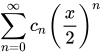
(a)
(b)

| Foundations: |
|---|
| Ratio Test |
| Let be a series and Failed to parse (MathML with SVG or PNG fallback (recommended for modern browsers and accessibility tools): Invalid response ("Math extension cannot connect to Restbase.") from server "https://wikimedia.org/api/rest_v1/":): {\displaystyle L=\lim_{n\rightarrow \infty}\bigg|\frac{a_{n+1}}{a_n}\bigg|.} |
| Then, |
|
If Failed to parse (MathML with SVG or PNG fallback (recommended for modern browsers and accessibility tools): Invalid response ("Math extension cannot connect to Restbase.") from server "https://wikimedia.org/api/rest_v1/":): {\displaystyle L<1,} the series is absolutely convergent. |
|
If Failed to parse (MathML with SVG or PNG fallback (recommended for modern browsers and accessibility tools): Invalid response ("Math extension cannot connect to Restbase.") from server "https://wikimedia.org/api/rest_v1/":): {\displaystyle L>1,} the series is divergent. |
|
If Failed to parse (MathML with SVG or PNG fallback (recommended for modern browsers and accessibility tools): Invalid response ("Math extension cannot connect to Restbase.") from server "https://wikimedia.org/api/rest_v1/":): {\displaystyle L=1,} the test is inconclusive. |

Solution:
(a)
| Step 1: |
|---|
| Assume that the power series Failed to parse (MathML with SVG or PNG fallback (recommended for modern browsers and accessibility tools): Invalid response ("Math extension cannot connect to Restbase.") from server "https://wikimedia.org/api/rest_v1/":): {\displaystyle \sum_{n=0}^\infty c_nx^n} converges. |
| Let Failed to parse (MathML with SVG or PNG fallback (recommended for modern browsers and accessibility tools): Invalid response ("Math extension cannot connect to Restbase.") from server "https://wikimedia.org/api/rest_v1/":): {\displaystyle R} be the radius of convergence of this power series. |
| We can use the Ratio Test to find Failed to parse (MathML with SVG or PNG fallback (recommended for modern browsers and accessibility tools): Invalid response ("Math extension cannot connect to Restbase.") from server "https://wikimedia.org/api/rest_v1/":): {\displaystyle R.} |
| Using the Ratio Test, we have |
|
Failed to parse (MathML with SVG or PNG fallback (recommended for modern browsers and accessibility tools): Invalid response ("Math extension cannot connect to Restbase.") from server "https://wikimedia.org/api/rest_v1/":): {\displaystyle \begin{array}{rcl} \displaystyle{\lim_{n\rightarrow \infty} \bigg| \frac{c_{n+1}x^{n+1}}{c_nx^n}\bigg|} & = & \displaystyle{\lim_{n\rightarrow \infty} \bigg|\frac{c_{n+1}x}{c_n}\bigg|}\\ &&\\ & = & \displaystyle{|x|\lim_{n\rightarrow \infty}\bigg(\frac{c_{n+1}}{c_n}\bigg).} \end{array}} |
| Since the radius of convergence of the series Failed to parse (MathML with SVG or PNG fallback (recommended for modern browsers and accessibility tools): Invalid response ("Math extension cannot connect to Restbase.") from server "https://wikimedia.org/api/rest_v1/":): {\displaystyle \sum_{n=0}^\infty c_nx^n} is Failed to parse (MathML with SVG or PNG fallback (recommended for modern browsers and accessibility tools): Invalid response ("Math extension cannot connect to Restbase.") from server "https://wikimedia.org/api/rest_v1/":): {\displaystyle R,} we have |
| Failed to parse (MathML with SVG or PNG fallback (recommended for modern browsers and accessibility tools): Invalid response ("Math extension cannot connect to Restbase.") from server "https://wikimedia.org/api/rest_v1/":): {\displaystyle R=\frac{1}{\displaystyle{\lim_{n\rightarrow \infty} \bigg(\frac{c_{n+1}}{c_n}\bigg)}}.} |
| Step 2: |
|---|
| Now, we use the Ratio Test to find the radius of convergence of the series Failed to parse (MathML with SVG or PNG fallback (recommended for modern browsers and accessibility tools): Invalid response ("Math extension cannot connect to Restbase.") from server "https://wikimedia.org/api/rest_v1/":): {\displaystyle \sum_{n=0}^\infty c_n\bigg(\frac{x}{2}\bigg)^n.} |
| Using the Ratio Test, we have |
| Failed to parse (MathML with SVG or PNG fallback (recommended for modern browsers and accessibility tools): Invalid response ("Math extension cannot connect to Restbase.") from server "https://wikimedia.org/api/rest_v1/":): {\displaystyle \begin{array}{rcl} \displaystyle{\lim_{n\rightarrow \infty} \bigg| \frac{c_{n+1}2^nx^{n+1}}{c_n2^{n+1}x^n}\bigg|} & = & \displaystyle{\lim_{n\rightarrow \infty} \bigg|\frac{c_{n+1}x}{2c_n}\bigg|}\\ &&\\ & = & \displaystyle{\frac{|x|}{2}\lim_{n\rightarrow \infty}\bigg(\frac{c_{n+1}}{c_n}\bigg).} \end{array}} |
| Hence, the radius of convergence of this power series is |
| Failed to parse (MathML with SVG or PNG fallback (recommended for modern browsers and accessibility tools): Invalid response ("Math extension cannot connect to Restbase.") from server "https://wikimedia.org/api/rest_v1/":): {\displaystyle \frac{2}{\displaystyle{\lim_{n\rightarrow \infty} \bigg(\frac{c_{n+1}}{c_n}\bigg)}}=2R.} |
| Therefore, this power series converges. |
(b)
| Step 1: |
|---|
| Assume that the power series Failed to parse (MathML with SVG or PNG fallback (recommended for modern browsers and accessibility tools): Invalid response ("Math extension cannot connect to Restbase.") from server "https://wikimedia.org/api/rest_v1/":): {\displaystyle \sum_{n=0}^\infty c_nx^n} converges. |
| Let Failed to parse (MathML with SVG or PNG fallback (recommended for modern browsers and accessibility tools): Invalid response ("Math extension cannot connect to Restbase.") from server "https://wikimedia.org/api/rest_v1/":): {\displaystyle R} be the radius of convergence of this power series. |
| We can use the Ratio Test to find Failed to parse (MathML with SVG or PNG fallback (recommended for modern browsers and accessibility tools): Invalid response ("Math extension cannot connect to Restbase.") from server "https://wikimedia.org/api/rest_v1/":): {\displaystyle R.} |
| Using the Ratio Test, we have |
|
Failed to parse (MathML with SVG or PNG fallback (recommended for modern browsers and accessibility tools): Invalid response ("Math extension cannot connect to Restbase.") from server "https://wikimedia.org/api/rest_v1/":): {\displaystyle \begin{array}{rcl} \displaystyle{\lim_{n\rightarrow \infty} \bigg| \frac{c_{n+1}x^{n+1}}{c_nx^n}\bigg|} & = & \displaystyle{\lim_{n\rightarrow \infty} \bigg|\frac{c_{n+1}x}{c_n}\bigg|}\\ &&\\ & = & \displaystyle{|x|\lim_{n\rightarrow \infty}\bigg(\frac{c_{n+1}}{c_n}\bigg).} \end{array}} |
| Since the radius of convergence of the series Failed to parse (MathML with SVG or PNG fallback (recommended for modern browsers and accessibility tools): Invalid response ("Math extension cannot connect to Restbase.") from server "https://wikimedia.org/api/rest_v1/":): {\displaystyle \sum_{n=0}^\infty c_nx^n} is Failed to parse (MathML with SVG or PNG fallback (recommended for modern browsers and accessibility tools): Invalid response ("Math extension cannot connect to Restbase.") from server "https://wikimedia.org/api/rest_v1/":): {\displaystyle R,} we have |
| Failed to parse (MathML with SVG or PNG fallback (recommended for modern browsers and accessibility tools): Invalid response ("Math extension cannot connect to Restbase.") from server "https://wikimedia.org/api/rest_v1/":): {\displaystyle R=\frac{1}{\displaystyle{\lim_{n\rightarrow \infty} \bigg(\frac{c_{n+1}}{c_n}\bigg)}}.} |
| Step 2: |
|---|
| Now, we use the Ratio Test to find the radius of convergence of the series Failed to parse (MathML with SVG or PNG fallback (recommended for modern browsers and accessibility tools): Invalid response ("Math extension cannot connect to Restbase.") from server "https://wikimedia.org/api/rest_v1/":): {\displaystyle \sum_{n=0}^\infty c_n(-x)^n .} |
| Using the Ratio Test, we have |
| Failed to parse (MathML with SVG or PNG fallback (recommended for modern browsers and accessibility tools): Invalid response ("Math extension cannot connect to Restbase.") from server "https://wikimedia.org/api/rest_v1/":): {\displaystyle \begin{array}{rcl} \displaystyle{\lim_{n\rightarrow \infty} \bigg| \frac{c_{n+1}(-x)^{n+1}}{c_n(-x)^n}\bigg|} & = & \displaystyle{\lim_{n\rightarrow \infty} \bigg|\frac{c_{n+1}(-x)}{c_n}\bigg|}\\ &&\\ & = & \displaystyle{|x|\lim_{n\rightarrow \infty}\bigg(\frac{c_{n+1}}{c_n}\bigg).} \end{array}} |
| Hence, the radius of convergence of this power series is |
| Failed to parse (MathML with SVG or PNG fallback (recommended for modern browsers and accessibility tools): Invalid response ("Math extension cannot connect to Restbase.") from server "https://wikimedia.org/api/rest_v1/":): {\displaystyle \frac{1}{\displaystyle{\lim_{n\rightarrow \infty} \bigg(\frac{c_{n+1}}{c_n}\bigg)}}=R.} |
| Therefore, this power series converges. |
| Final Answer: |
|---|
| (a) converges |
| (b) converges |