Difference between revisions of "009B Sample Final 1, Problem 3"
| Line 1: | Line 1: | ||
<span class="exam">Consider the area bounded by the following two functions: | <span class="exam">Consider the area bounded by the following two functions: | ||
| − | :: | + | ::<span class="exam"><math style="vertical-align: -4px">y=\cos x</math> and <math style="vertical-align: -4px">y=2-\cos x,~0\le x\le 2\pi.</math> |
| − | + | <span class="exam">(a) Sketch the graphs and find their points of intersection. | |
| − | + | <span class="exam">(b) Find the area bounded by the two functions. | |
{| class="mw-collapsible mw-collapsed" style = "text-align:left;" | {| class="mw-collapsible mw-collapsed" style = "text-align:left;" | ||
!Foundations: | !Foundations: | ||
|- | |- | ||
| − | | | + | |'''1.''' You can find the intersection points of two functions, say <math style="vertical-align: -5px">f(x),g(x),</math> |
|- | |- | ||
| | | | ||
| − | + | by setting <math style="vertical-align: -5px">f(x)=g(x)</math> and solving for <math style="vertical-align: 0px">x.</math> | |
|- | |- | ||
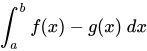
| − | | | + | |'''2.''' The area between two functions, <math style="vertical-align: -5px">f(x)</math> and <math style="vertical-align: -5px">g(x),</math> is given by <math>\int_a^b f(x)-g(x)~dx</math> |
| − | |||
| − | |||
| − | |||
| − | |||
|- | |- | ||
| | | | ||
| − | + | for <math style="vertical-align: -3px">a\leq x\leq b,</math> where <math style="vertical-align: -5px">f(x)</math> is the upper function and <math style="vertical-align: -5px">g(x)</math> is the lower function. | |
|} | |} | ||
| + | |||
'''Solution:''' | '''Solution:''' | ||
| Line 33: | Line 30: | ||
|First, we graph these two functions. | |First, we graph these two functions. | ||
|- | |- | ||
| − | | | + | | |
|} | |} | ||
| Line 39: | Line 36: | ||
!Step 2: | !Step 2: | ||
|- | |- | ||
| − | |Setting <math style="vertical-align: - | + | |Setting <math style="vertical-align: -4px">\cos x=1-\cos x,</math> we get <math style="vertical-align: 0px">2\cos x=2.</math> |
|- | |- | ||
| − | | | + | |Therefore, we have |
| − | + | |- | |
| + | | <math>\cos x=1.</math> | ||
| + | |- | ||
| + | |In the interval <math style="vertical-align: -4px">0\le x\le 2\pi,</math> the solutions to this equation are | ||
| + | |- | ||
| + | | <math style="vertical-align: 0px">x=0</math> and <math style="vertical-align: 0px">x=2\pi.</math> | ||
| + | |- | ||
| + | |Plugging these values into our equations, | ||
|- | |- | ||
| − | | | + | |we get the intersection points <math style="vertical-align: -4px">(0,1)</math> and <math style="vertical-align: -4px">(2\pi,1).</math> |
|- | |- | ||
|You can see these intersection points on the graph shown in Step 1. | |You can see these intersection points on the graph shown in Step 1. | ||
| Line 54: | Line 58: | ||
!Step 1: | !Step 1: | ||
|- | |- | ||
| − | | | + | |The area bounded by the two functions is given by |
|- | |- | ||
| | | | ||
| − | + | <math>\int_0^{2\pi} (2-\cos x)-\cos x~dx.</math> | |
|- | |- | ||
| | | | ||
| Line 68: | Line 72: | ||
|- | |- | ||
| | | | ||
| − | + | <math>\begin{array}{rcl} | |
| − | \displaystyle{ | + | \displaystyle{\int_0^{2\pi} (2-\cos x)-\cos x~dx} & {=} & \displaystyle{\int_0^{2\pi} 2-2\cos x~dx}\\ |
&&\\ | &&\\ | ||
| − | & = & \displaystyle{ | + | & = & \displaystyle{(2x-2\sin x)\bigg|_0^{2\pi}}\\ |
&&\\ | &&\\ | ||
| − | & = & \displaystyle{2\ | + | & = & \displaystyle{(4\pi-2\sin(2\pi))-(0-2\sin(0))}\\ |
&&\\ | &&\\ | ||
| − | & = & \displaystyle{ | + | & = & \displaystyle{4\pi.}\\ |
\end{array}</math> | \end{array}</math> | ||
|} | |} | ||
| + | |||
{| class="mw-collapsible mw-collapsed" style = "text-align:left;" | {| class="mw-collapsible mw-collapsed" style = "text-align:left;" | ||
!Final Answer: | !Final Answer: | ||
|- | |- | ||
| − | | '''(a)''' <math>(0, | + | | '''(a)''' <math>(0,1),(2\pi,1)</math> (See Step 1 above for graph) |
|- | |- | ||
| − | | '''(b)''' <math> | + | | '''(b)''' <math>4\pi</math> |
|} | |} | ||
[[009B_Sample_Final_1|'''<u>Return to Sample Exam</u>''']] | [[009B_Sample_Final_1|'''<u>Return to Sample Exam</u>''']] | ||
Revision as of 09:43, 10 April 2017
Consider the area bounded by the following two functions:
- and


(a) Sketch the graphs and find their points of intersection.
(b) Find the area bounded by the two functions.
| Foundations: |
|---|
| 1. You can find the intersection points of two functions, say |
|
by setting and solving for |
| 2. The area between two functions, and is given by |
|
for where is the upper function and is the lower function. |




Solution:
(a)
| Step 1: |
|---|
| First, we graph these two functions. |
| Step 2: |
|---|
| Setting Failed to parse (Conversion error. Server ("https://wikimedia.org/api/rest_") reported: "Cannot get mml. Server problem."): {\displaystyle \cos x=1-\cos x,} we get |
| Therefore, we have |
| In the interval the solutions to this equation are |
| Failed to parse (MathML with SVG or PNG fallback (recommended for modern browsers and accessibility tools): Invalid response ("Math extension cannot connect to Restbase.") from server "https://wikimedia.org/api/rest_v1/":): {\displaystyle x=0} and Failed to parse (MathML with SVG or PNG fallback (recommended for modern browsers and accessibility tools): Invalid response ("Math extension cannot connect to Restbase.") from server "https://wikimedia.org/api/rest_v1/":): {\displaystyle x=2\pi.} |
| Plugging these values into our equations, |
| we get the intersection points Failed to parse (MathML with SVG or PNG fallback (recommended for modern browsers and accessibility tools): Invalid response ("Math extension cannot connect to Restbase.") from server "https://wikimedia.org/api/rest_v1/":): {\displaystyle (0,1)} and Failed to parse (MathML with SVG or PNG fallback (recommended for modern browsers and accessibility tools): Invalid response ("Math extension cannot connect to Restbase.") from server "https://wikimedia.org/api/rest_v1/":): {\displaystyle (2\pi,1).} |
| You can see these intersection points on the graph shown in Step 1. |


(b)
| Step 1: |
|---|
| The area bounded by the two functions is given by |
|
Failed to parse (MathML with SVG or PNG fallback (recommended for modern browsers and accessibility tools): Invalid response ("Math extension cannot connect to Restbase.") from server "https://wikimedia.org/api/rest_v1/":): {\displaystyle \int_0^{2\pi} (2-\cos x)-\cos x~dx.} |
| Step 2: |
|---|
| Lastly, we integrate to get |
|
Failed to parse (MathML with SVG or PNG fallback (recommended for modern browsers and accessibility tools): Invalid response ("Math extension cannot connect to Restbase.") from server "https://wikimedia.org/api/rest_v1/":): {\displaystyle \begin{array}{rcl} \displaystyle{\int_0^{2\pi} (2-\cos x)-\cos x~dx} & {=} & \displaystyle{\int_0^{2\pi} 2-2\cos x~dx}\\ &&\\ & = & \displaystyle{(2x-2\sin x)\bigg|_0^{2\pi}}\\ &&\\ & = & \displaystyle{(4\pi-2\sin(2\pi))-(0-2\sin(0))}\\ &&\\ & = & \displaystyle{4\pi.}\\ \end{array}} |
| Final Answer: |
|---|
| (a) Failed to parse (MathML with SVG or PNG fallback (recommended for modern browsers and accessibility tools): Invalid response ("Math extension cannot connect to Restbase.") from server "https://wikimedia.org/api/rest_v1/":): {\displaystyle (0,1),(2\pi,1)} (See Step 1 above for graph) |
| (b) Failed to parse (MathML with SVG or PNG fallback (recommended for modern browsers and accessibility tools): Invalid response ("Math extension cannot connect to Restbase.") from server "https://wikimedia.org/api/rest_v1/":): {\displaystyle 4\pi} |