Difference between revisions of "022 Exam 2 Sample B, Problem 1"
Jump to navigation
Jump to search
| Line 4: | Line 4: | ||
!Foundations: | !Foundations: | ||
|- | |- | ||
| − | |This problem | + | |This problem is best approached through properties of logarithms. Remember that |
|- | |- | ||
| − | | | + | |<br> <math>\ln (xy) = \ln x + \ln y,</math> |
|- | |- | ||
| − | + | |while | |
| − | | | ||
|- | |- | ||
| − | | | + | | <math>\ln \left( \frac{x}{y}\right) = \ln x - \ln y,</math> |
|- | |- | ||
| − | | | + | |and |
|- | |- | ||
| − | | | + | | <math>\ln \left( x^n \right) = n\ln x,</math> |
|- | |- | ||
| − | | | + | |You will also need to apply |
|- | |- | ||
| − | | | + | |'''The Chain Rule:''' If <math style="vertical-align: -25%;">f</math> and <math style="vertical-align: -15%;">g</math> are differentiable functions, then |
|- | |- | ||
| − | | | + | |
| − | + | | <math>(f\circ g)'(x) = f'(g(x))\cdot g'(x).</math> | |
|- | |- | ||
| − | | | + | |
| + | |Finally, recall that the derivative of natural log is | ||
|- | |- | ||
| | | | ||
| Line 36: | Line 36: | ||
!Step 1: | !Step 1: | ||
|- | |- | ||
| − | |We | + | |We can use the log rules to rewrite our function as |
|- | |- | ||
| + | |<br> | ||
| + | ::<math>\begin{array}{rcl} | ||
| + | y' & = & \displaystyle{\ln \frac{(x+1)^4}{(2x - 5)(x + 4)}}\\ | ||
| + | \\ | ||
| + | & = & 4\ln (x+1)-\ln(2x-5)-\ln (x+4). | ||
| + | |||
| + | \end{array}</math> | ||
| | | | ||
| − | |||
|- | |- | ||
| − | | | + | |- |
|} | |} | ||
| Line 47: | Line 53: | ||
!Step 2: | !Step 2: | ||
|- | |- | ||
| − | |We can | + | |We can differentiate term-by-term, applying the chain rule to each term to find |
|- | |- | ||
|<br> | |<br> | ||
::<math>\begin{array}{rcl} | ::<math>\begin{array}{rcl} | ||
| − | + | y' & = & \displaystyle{4 \cdot \frac{1}{x+1}\cdot(x+1)' - \frac{1}{2x-5}\cdot(2x-5)' - \frac{1}{x+4} \cdot (x+4)'}\\ | |
\\ | \\ | ||
| − | &=&\displaystyle{\frac{ | + | & = & \displaystyle{\frac{4}{x+1}-\frac{2}{2x-5}-\frac{1}{x+4}}. |
| + | |||
\end{array}</math> | \end{array}</math> | ||
| | | | ||
| − | |||
| − | |||
| − | |||
| − | |||
| − | |||
| − | |||
| − | |||
| − | |||
| − | |||
| − | |||
| − | |||
| − | |||
| − | |||
| − | |||
| − | |||
| − | |||
| − | |||
|} | |} | ||
| Line 78: | Line 68: | ||
!Final Answer: | !Final Answer: | ||
|- | |- | ||
| − | |<math>y'=\ | + | |<br><math>y'\,=\,\displaystyle{\frac{4}{x+1}-\frac{2}{2x-5}-\frac{1}{x+4}}.</math> |
|} | |} | ||
[[022_Exam_2_Sample_B|'''<u>Return to Sample Exam</u>''']] | [[022_Exam_2_Sample_B|'''<u>Return to Sample Exam</u>''']] | ||
Revision as of 21:21, 20 January 2017
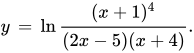
Find the derivative of
| Foundations: | |
|---|---|
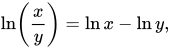
| This problem is best approached through properties of logarithms. Remember that | |
| while | |
| and | |
| You will also need to apply | |
| The Chain Rule: If and are differentiable functions, then | |
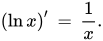
| Finally, recall that the derivative of natural log is | |
|
|





Solution:
| Step 1: | |
|---|---|
| We can use the log rules to rewrite our function as | |

| Step 2: | |
|---|---|
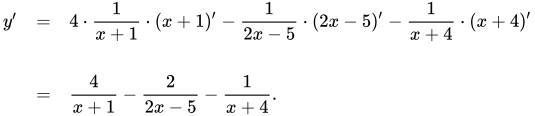
| We can differentiate term-by-term, applying the chain rule to each term to find | |
| Final Answer: |
|---|
