Difference between revisions of "009A Sample Final A, Problem 9"
Jump to navigation
Jump to search
m |
m |
||
| Line 38: | Line 38: | ||
| <math>\frac{dz}{dt} = \frac {3}{5}\cdot(-30) = -18.</math> | | <math>\frac{dz}{dt} = \frac {3}{5}\cdot(-30) = -18.</math> | ||
|} | |} | ||
| + | |||
| + | [[009A_Sample_Final_A|'''<u>Return to Sample Exam</u>''']] | ||
Revision as of 23:02, 23 March 2015

9. A bug is crawling along the Failed to parse (Conversion error. Server ("https://wikimedia.org/api/rest_") reported: "Cannot get mml. Server problem."): {\displaystyle x}
-axis at a constant speed of .
How fast is the distance between the bug and the point changing
when the bug is at the origin? (Note that if the distance is decreasing, then you should have a negative answer).


| Foundations: |
|---|
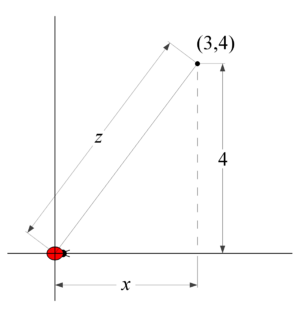
| Like most geometric word problems, you should start with a picture. This will help you declare variables and write meaningful equation(s). In this case, we will have to use implicit differentiation to arrive at our related rate. In particular, we need to choose variables to describe the distance between the bug and the point (3,4), which we can call z. By the given information, we can consider the position on the x-axis simply as x. |
Solution:
| Step 1: |
|---|
| Write the Basic Equation: From the picture, we can see there is a triangle involving both the bug and the point (3,4). From this, we can see that |

| Step 2: |
|---|
| Use Implicit Differentiation: We take the derivative of the equation from Step 1 to find |
| Failed to parse (MathML with SVG or PNG fallback (recommended for modern browsers and accessibility tools): Invalid response ("Math extension cannot connect to Restbase.") from server "https://wikimedia.org/api/rest_v1/":): {\displaystyle 2z\frac{dz}{dt} = 2x\frac{dx}{dt},} |
| or |
| Failed to parse (MathML with SVG or PNG fallback (recommended for modern browsers and accessibility tools): Invalid response ("Math extension cannot connect to Restbase.") from server "https://wikimedia.org/api/rest_v1/":): {\displaystyle \frac{dz}{dt} = \frac{x}{z}\cdot\frac{dx}{dt},} |
| Step 3: |
|---|
| Evaluate and Solve: When the bug is at the origin, we have x = 3. By the Pythagorean Theorem, z = 5. Based on our drawing, x is actually decreasing at a rate of 30, so we should really write Failed to parse (MathML with SVG or PNG fallback (recommended for modern browsers and accessibility tools): Invalid response ("Math extension cannot connect to Restbase.") from server "https://wikimedia.org/api/rest_v1/":): {\displaystyle dx/dt = -30} . We now simply plug in to the result of our implicit differentiation to find |
| Failed to parse (MathML with SVG or PNG fallback (recommended for modern browsers and accessibility tools): Invalid response ("Math extension cannot connect to Restbase.") from server "https://wikimedia.org/api/rest_v1/":): {\displaystyle \frac{dz}{dt} = \frac {3}{5}\cdot(-30) = -18.} |