Difference between revisions of "Section 1.11"
(Created page with "'''7.''' Show that two 2-dimensional subspaces of a 3-dimensional subspace must have nontrivial intersection.<br /> <br /> {| class="mw-collapsible mw-collapsed" style = "text...") |
(No difference)
|
Latest revision as of 23:17, 15 November 2015
7. Show that two 2-dimensional subspaces of a 3-dimensional subspace must have nontrivial intersection.
| Proof: |
|---|
| (by contradiction) Suppose are both 2-dimensional subspaces of a 3-dimension vector space and assume that have trivial intersection. Then is also a subspace of , and since have a trivial intersection . But then: . However subspaces must have a smaller dimension than the whole vector space and . This is a contradiction and so must have trivial intersection. |





8. Let be subspaces of a finite dimensional vector space . Show that .


| Proof: |
|---|
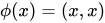
| Define the linear map by . Then by dimension formula First note that in general . This fact I won’t prove here but is why . Now . That is, iff . But since and and they are actually the same vector, , then we must have . That says that the elements of the kernel are ordered pairs where the first and second component are equal and must be in . Then we can write . I claim that this is isomorphic to . To prove this consider the function as . This map is an isomorphism which you can check. Since we have an isomorphism, the dimensions must equal and so . Finally let us examine . I claim that . Note, this is equal and not just isomorphic. To see this, we note that if then by subspace property. So then any is also equal to . So these sets do indeed contain the exact same elements. That means . Putting this all together gives: . |







16. Show that the matrix
as a linear map satisfies .


| Proof: |
|---|
| The matrix is already in eschelon form and has one pivot in the second column. That means that a basis for the column space which is the same as the image would be the second column. In other words, . Now for the kernel space. Writing out the equation reads or in other words . Then an arbitrary element of the kernel . So again . In other words, . |


17. Show that
defines a projection for all . Compute the kernel and image.


| Proof: |
|---|
| First I will deal with the case . In this case the matrix is and we see by the procedure in the last problem that: and .
|


